

Get 2025 Free CIPS L4M2 Exam Practice Materials Collection
Get Latest and 100% Accurate L4M2 Exam Questions
NEW QUESTION # 46
Which of the following are typical social considerations throughout the contract life cycle? Select the TWO that apply.
- A. Minimizing use of non-renewable resources
- B. Managing waste
- C. Using recycled materials
- D. Health and safety
- E. Support small local businesses
Answer: D,E
Explanation:
The following are typical social criteria in procurement:
* Reducing unemployment
* Preventing the use of child labour
* Preventing discrimination on the grounds of race, religion, disability, sex or sexual orientation
* Encouraging good employment practice
* Reducing local unemployment
* Reducing social exclusion
* Promoting training opportunities for the young or disadvantaged
* Encouraging access to work for people with disabilities
Reference: CIPS study guide page 137
LO 3, AC 3.2
NEW QUESTION # 47
Which of the following sources of information are considered as primary data? Select TWO that apply.
- A. The collection of data from surveying customers
- B. RFI
- C. Reports in business magazines
- D. Commercial publishers of market reports
- E. The information about specific market sectors from trade associations
Answer: A,B
Explanation:
The aim of this question is to check students' understanding of different types of data. There are 2 types of data:
- Primary data is the collection of original or raw data which are generated from field research. In this case, only RFI and surveys from customers are considered as primary data.
- On the other hand, secondary data is public information that has been collected by others. It is typically free or inexpensive to obtain and can act as a strong foundation to any research project - provided you know where to find it and how to judge its worth and relevance. Examples of secondary data are government statistics, industry associations, trade publications, published market reports, etc.
Reference: CIPS study guide page 22-24
LO 1, AC 1.2
NEW QUESTION # 48
Which of the following is the purpose of benchmarking?
- A. To copy other organisation's intellectual properties, processes and practices
- B. To identify and adapt the best practices to improve organisation's performance
- C. To coerce all suppliers to sacrifice their profit
- D. To resist continuous improvement
Answer: B
Explanation:
According to US Department of the Navy, Benchmarking is a strategic and analytic process of continuously measuring an organisation's products, services, and practices against a recognised leader in the studied area.
Successful benchmarking will help you:
- Find who does the process best and close the gap
- Recognise the leading organisations in a process or activity
- Create performance standards derived from an analysis of the best in business
- Ensure that comparisons are relevant
- Measure your performance, your processes, and your strategies against best in business
- Measure business processes
- Assess performance over time
- Accelerate continuous process improvement (CPI)
- Establish more credible goals for CPI
- Establish actionable objectives
- Discover and clarify new goals
- Establish customer expectations of business standards set by the best suppliers in industry
- Help your organisation achieve breakthrough improvements
- Create a sense of urgency for change
- Increase customer satisfaction
- Become direction setting
- Provide a positive, proactive structured process
Benchmarking does not:
- Copy the other's processes
- Steal other business confidentiality
- Stop. Benchmarking is a continuous process.
NEW QUESTION # 49
A procurement team is categorising their purchased items into four quadrants of Kraljic's supply chain portfolio matrix. They realise that there are some low-value items which come from very few suppliers in the market. The organisation is critically dependent on these suppliers. The team plans to reduce the dependence by finding alternative sources. Is this a right course of action?
- A. Yes, this action will dramatically increase the supplier's bargaining power
- B. No, there is no way to escape this dependency
- C. No, the organisation should run competitive biddings to exploit the competition
- D. Yes, the organisation needs to reduce the supply risks
Answer: D
Explanation:
According to Kraljic portfolio matrix, the low-value items with high supply risk are bottleneck items.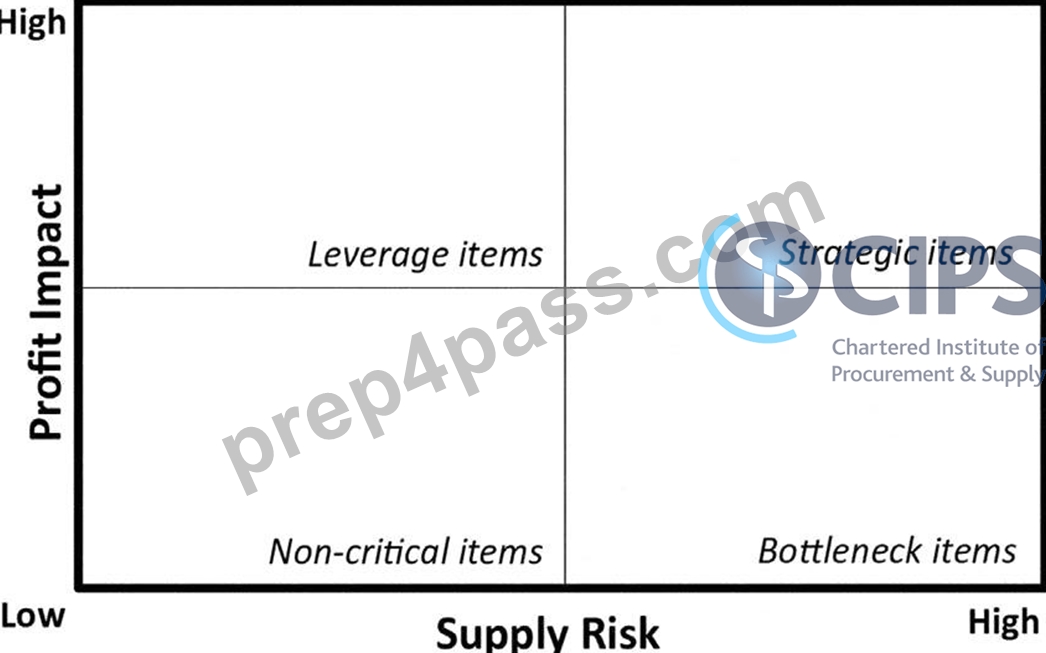
The purchasing strategy that is commonly recommended for these products is primarily based on acceptance of the dependence and reduction of the negative effects of the unfavourable position. An alternative strategy suggested by purchasing practitioners is to find other suppliers and move towards the non-critical quadrant.
- Accept dependence, reduce negative consequences: The main focus of this strategy is to assure supply, if necessary even at additional cost. Examples of this strategy are keeping extra stocks of the materials concerned or developing consigned stock agreements with suppliers. By performing a risk analysis firms can identify the most important bottleneck products and consider the implications. A possible action for dealing with unexpected bad dependence positions for certain products is to employ contingency planning.
- Reduce dependence and risk, find other solutions: This strategy is geared towards reducing the dependence on the supplier. The most common way to achieve this is to broaden the specifications of the product or to search for new suppliers.
The procurement team in the scenario has selected reducing dependency by finding alternatives. This is a right strategy for bottleneck item.
Reference:
- CIPS study guide page 82-84
- Purchasing strategies in the Kraljic matrix-A power and dependence perspective, Marjolein C.J. Caniels, Cees J. Gelderman LO 2, AC 2.1
NEW QUESTION # 50
This is the information on an organisation's activities over the past year
* Sale were $5,000,000. The value of accounts receivable was $450,000 at the start of the year and $525,000 at the end of the year
* The value of direct costs was $2,500,000 and 75% of this was bought on credit
* Indirect costs were $3,000,000 and 25% of this was bought on credit
* During the year the organization spent $1,500,000 on new assets and sold $150,000 of old assets. $1,000,000 of the spend on assets was funded by a bank loan
* The organization declared a dividend of $200,000 at the end of the year but this was not paid for another two months
* Opening balance was $175,000
Which of the following is the bank balance of that organization at the end of the year?
- A. $2,025,000
- B. $1,700,000
- C. $1,875,000
- D. $1,675,000
Answer: C
Explanation:
In this question, you should understand the concept of cash flow and formula of cash flow. Cash flow calculates the physical money moving in and out a company's bank balance. The cash flow from sale activity is:
cash flow from sale = account receivable at beginning of the year + revenue - account receivable at the end of the year = $450,000 + $5,000,000 - $525,000 = $4,925,000
75% of direct costs was bought by credit, therefore, the company spent 25% on direct cost: -$2,500,000*25/100 = -$625,000
25% of indirect costs was bought on credit. Cash flow out on indirect costs is: -$3,000,000*75/100 = -$2,250,000 Company spent $1,500,000 on new assets funded by a loan of $1,000,000. Cash flow out from this activity is -$500,000 Company received $150,000 from selling old assets Dividends have not been paid for another 2 months, thus, they are not accounted as cash flow out.
The bank balance at the end of the year is: $175,000 + $4,925,000 - $625,000 - $2,250,000 - $500,000 + $150,000 = $1,875,000 LO 1, AC 1.4
NEW QUESTION # 51
Buyers can ascertain the prices by examining information provided by primary and secondary sources of market data. Which of the following is a secondary source of market data?
- A. Supplier prices provided on price comparison websites
- B. Price brochures provided by the supplier's sales team
- C. Suppliers' prices provided on the buyer's request for quotation
- D. Historical records of supplier prices on the buyer's database
Answer: A
Explanation:
Detailed Explanation:
Price comparison websites are secondary sources as they aggregate data collected from multiple suppliers.
Primary sources (like RFQs and brochures) come directly from the supplier. Reference: CIPS Level 4, Market Data Analysis.
NEW QUESTION # 52
Which of the following are the focuses of ISO 14001:2015?
- A. 1 and 2 only
- B. 1. Life cycle
2. Process
3. Capacity
4. Information security
2 and 4 only - C. 3 and 4 only
- D. 2 and 3 only
Answer: A
Explanation:
ISO 14001:2015 specifies the requirements for an environmental management system that an or-ganization can use to enhance its environmental performance. ISO 14001:2015 is intended for use by an organization seeking to manage its environmental responsibilities in a systematic manner that contributes to the environmental pillar of sustainability.
ISO 14001:2015 helps an organization achieve the intended outcomes of its environmental man-agement system, which provide value for the environment, the organization itself and interested parties. Consistent with the organization's environmental policy, the intended outcomes of an environmental management system include:
* enhancement of environmental performance;
* fulfilment of compliance obligations;
* achievement of environmental objectives.
ISO 14001:2015 is applicable to any organization, regardless of size, type and nature, and applies to the environmental aspects of its activities, products and services that the organization determines it can either control or influence considering a life cycle perspective. ISO 14001:2015 does not state specific environmental performance criteria.
ISO 14001:2015 can be used in whole or in part to systematically improve environmental manage-ment.
Claims of conformity to ISO 14001:2015, however, are not acceptable unless all its require-ments are incorporated into an organization's environmental management system and fulfilled without exclusion.
In conclusion, ISO 14001:2015 focuses on: management system (including roles, leadership and processes) and the life cycle of product or service. Life cycle is defined as "consecutive and inter-linked stages of a product (or service) system, from raw material acquisition or generation from natural resources to final disposal. [...] The life cycle stages include acquisition of raw materials, design, production, transportation/ delivery, use, end-of-life treatment and final disposal." The answer is process and life cycle.
Reference:
- ISO 14001:2015 Environmental management systems - Requirements with guidance for use LO 3, AC 3.1
NEW QUESTION # 53
Housing Ltd is inviting a number of contractors to a tender for the construction of a commercial building. In the attachment to the invitation to tender, there is a document which describes the re-quired materials and installation methods. This document is known as...?
- A. Drawings
- B. Prescriptive specification
- C. Functional specification
- D. Performance specification
Answer: B
Explanation:
This question mentions about specification in construction. In this sector, specifications are written documents that describe the materials and workmanship required for a development. They do not include cost, quantity or drawn information and need to be read alongside other contract documentation such as quantities, schedules and drawings.
Specifications vary considerably depending on the stage to which the design has been developed, ranging from performance (open) specifications that require further development by a contractor or supplier, to prescriptive (closed) specifications for which the design is already complete when the project is tendered.
Prescriptive specifications typically contain detailed descriptions of the following components:
- General requirements relating to regulations and standards.
- The type of products and materials required.
- The execution and installation methods required.
Prescriptive specifications give the client much more certainty about the end product when making investment decisions (such as when they appoint the contractor), and place a greater burden on the designer to ensure proper installation rather than the contractor.
Reference:
- CIPS study guide page 116-120
- Prescriptive specification - Designing Buildings Wiki
LO 3, AC 3.1
NEW QUESTION # 54
A hospital extensively spends on medical and implantable devices, medical, surgical and pharma-ceutical supplies, costs of supplies related to buildings and maintenance operations. Hospital's procurement manager suggests that the hospital has an opportunity to reduce operational costs by reducing variation of medical devices and pharmaceutical supplies. Which of the following best describe the procurement manager's suggestion?
- A. Value engineering
- B. Process standardisation
- C. Process re-engineering
- D. Product standardisation
Answer: D
Explanation:
The hospital is buying too many product variants. This may cause bottleneck in its operation and increase operational expense. So procurement manager suggests to standardise products.
This is an example of the benefits of product standardisation:
Saint Thomas Health, a system of 5 hospitals, needed to find a way to reduce costs. They were purchasing different SKUs for products that were very similar, in this case, labels. They bought label rolls for $3 and a very similar product for $1. This oversight in product purchases impacted the overall costs of the system.
After partnering with a sole source vendor it was able to save $200,000 over a four year span. They accomplished this simply by standardizing label products. These savings, however, only account for the immediate savings from standardizing products. The saving that are not factored into that number are the savings from soft or hidden costs.
On a national scale, hospitals lose millions of dollars per year in hidden expenses due to missed opportunities for cost containment and incorporation. Some of the hidden elements that increase overall costs for a healthcare provider include the following:
- Redundant purchasing
- Freight
- Excessive purchase orders
- Multiple vendor relations
- Low efficiency
- Joint commission fines
- HAI
By implementing product standardization, hospitals and health systems reduce vendors, are able to reduce SKUs, purchase orders, inefficiency, freight costs, fines, and off-contract spending. All of this adds up to large savings for the organization as a whole.
96% of the respondents in the survey agree that consolidating suppliers and standardizing product purchases across organization would reduce hidden costs.
NEW QUESTION # 55
A supplier of software has received a request to quote for a product. The software supplier considers that the buying organisation making the request provides relatively little benefit or alignment to their own strategy. Which one of the following options describes how the supplier might react to the buyer?
- A. The supplier will attempt to foster a strategic relationship with the buyer
- B. The supplier will seek to exploit the situation and drive a high price
- C. The supplier will provide the buyer with attractive additional software support benefits
- D. The supplier will seek to offer the lowest price possible
Answer: B
Explanation:
Detailed Explanation:
When the buyer does not align with the supplier's strategic interests, the supplier may take advantage by charging higher prices to compensate for the perceived lack of value. This approach maximizes the supplier's benefit from a transactional relationship. Reference: CIPS Level 4, Supplier Engagement and Negotiation Strategies.
NEW QUESTION # 56
Which of the following is a risk to buying organization when using conformance specification?
- A. Time to produce specification is shortened
- B. Buyer may face liquidity risks
- C. Buyer cannot control the inputs
- D. Buyer is responsible for product failure
Answer: D
Explanation:
When using conformance specification, the buying organisation is responsible for the performance of the purchase. If the product fails due to poorly designed specification, the buyer is wholly responsible for it. It cannot blame the supplier for the failure because they still provided 'fit for purpose' product.
'Time to produce specification is shortened': Conformance specification requires details on dimen-sion, materials, design, etc. With such requirements, time to produce a complete conformance specification is often longer than producing performance specification.
'Buyer cannot control the inputs': Conformance specification is a list of inputs from buyer, so buyer has control over the inputs that will make the product. It also means that buyer is responsible for any product failure.
'Buyer may face liquidity risks': Liquidity means that how quick a business turns its assets into cash. This is a financial term, it does not link directly with specification failure.
Reference:
LO 3, AC 3.1
NEW QUESTION # 57
A procurement team is categorising their purchased items into four quadrants of Kraljic's supply chain portfolio matrix. They realise that there are some low-value items which come from very few suppliers in the market. The organisation is critically dependent on these suppliers. The team plans to reduce the dependence by finding alternative sources. Is this a right course of action?
- A. Yes, this action will dramatically increase the supplier's bargaining power
- B. No, there is no way to escape this dependency
- C. No, the organisation should run competitive biddings to exploit the competition
- D. Yes, the organisation needs to reduce the supply risks
Answer: D
Explanation:
According to Kraljic portfolio matrix, the low-value items with high supply risk are bottleneck items.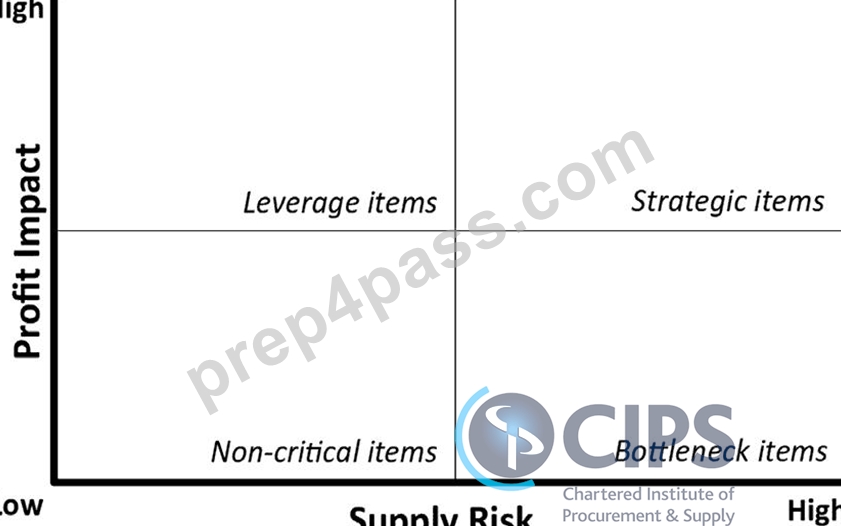
The purchasing strategy that is commonly recommended for these products is primarily based on acceptance of the dependence and reduction of the negative effects of the unfavourable position. An alternative strategy suggested by purchasing practitioners is to find other suppliers and move towards the non-critical quadrant.
- Accept dependence, reduce negative consequences: The main focus of this strategy is to assure supply, if necessary even at additional cost. Examples of this strategy are keeping extra stocks of the materials concerned or developing consigned stock agreements with suppliers. By performing a risk analysis firms can identify the most important bottleneck products and consider the implications. A possible action for dealing with unexpected bad dependence positions for certain products is to employ contingency planning.
- Reduce dependence and risk, find other solutions: This strategy is geared towards reducing the dependence on the supplier. The most common way to achieve this is to broaden the specifications of the product or to search for new suppliers.
The procurement team in the scenario has selected reducing dependency by finding alternatives. This is a right strategy for bottleneck item.
Reference:
- CIPS study guide page 82-84
- Purchasing strategies in the Kraljic matrix-A power and dependence perspective, Marjolein C.J. Caniels, Cees J. Gelderman LO 2, AC 2.1
NEW QUESTION # 58
When procuring a machinery, at which stage buyer must check whether it is working to the stand-ards set out in the design specification?
- A. Manufacture
- B. Installation
- C. Maintenance and repair activities
- D. Customer support
Answer: B
Explanation:
Through-life Management involves the life-cycle management of the products, services and activities required to deliver a fully integrated capability to the customer, while reducing the cost of ownership for the customer.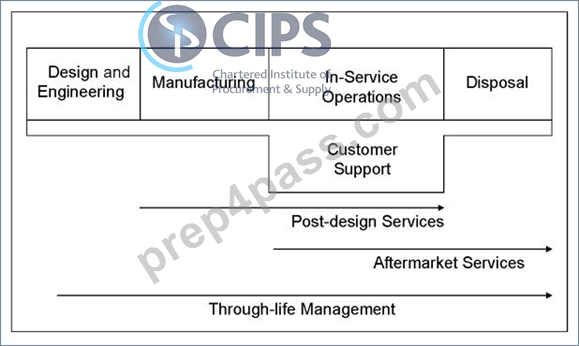
Source: Andrew Graves
The installation stage occurs in In-Service Operations. At this stage, the machinery is shipped and installed on the buyer's premises and check to ensure that it is working to the standards set out in the design specification.
Reference:
LO 3, AC 3.2
NEW QUESTION # 59
Which of the following are likely to be disadvantages of using outcome-based specifications? Select THREE that apply
- A. Ambiguity of outcome
- B. Stifling innovation
- C. Responsibility for product failure falling to buyer
- D. Difficulty to measure performance
- E. Time consuming to produce
- F. Long time delay between action and result
Answer: A,D,F
Explanation:
An Outcome Based Specification (OBS) focuses on the desired outcome of a service in business terms, rather than a detailed technical specification of how the service is to be provided; this allows providers scope to propose innovative solutions that might not have occurred to the procurement team. Outcome should be distinguished from output, which is the measurable results of a set of inputs. The example of difference between outcome and output is written at the bottom of page 123 in the study guide.
Outcomes should be the starting point in making new specification. However, using outcome-based specification has some setbacks:
- First, it is not easy to measure the outcomes. Usually, outcome of a project is a statement like 'increase customer satisfaction', 'maintain ambient temperature' or 'provide a convenient way to do something'. They are not easy to measure as output.
- Second, sometimes the desired outcomes require time to be materialised
- Third, outcomes can be ambiguous
Reference: CIPS study guide page 122-123
LO3, AC 3.1
NEW QUESTION # 60
Which of the following is an useful tool for value engineering?
- A. Kraljic Portfolio Matrix
- B. SAMOA
- C. Kano model
- D. Star-burst method
Answer: C
Explanation:
Value Engineering (VE) is concerned with new products. It is applied during product development. The focus is on reducing costs, improving function or both, by way of teamwork-based product evaluation and analysis.
This takes place before any capital is invested in tooling, plant or equipment.
This is very significant, because according to many reports, up to 80% of a product's costs (throughout the rest of its life-cycle), are locked in at the design development stage. This is under-standable when you consider the design of any product determines many factors, such as tooling, plant and equipment, labour and skills, training costs, materials, shipping, installation, maintenance, as well as decommissioning and recycle costs.
The Kano model is a theory for product development and customer satisfaction developed in the 1980s by Professor Noriaki Kano, which classifies customer preferences into five categories. Both Kano model and Value Engineering aims at optimising new product, so they can be combined to-gether. CIPS L4M2 study guide consider Kano model is a tool of Value Engineering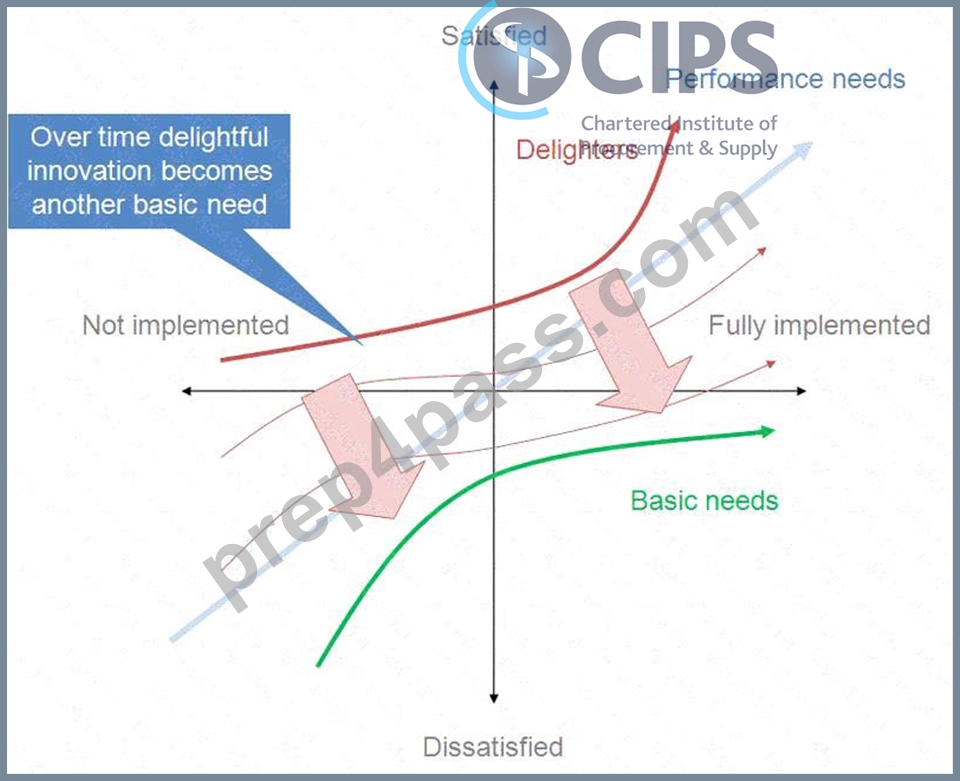
Example of Kano model (source: Wikipedia)
Reference: CIPS study guide page 171-172
LO 3, AC 3.4
NEW QUESTION # 61
At which stage of product life cycle, price competition between sellers will be the most intense?
- A. Introductory stage
- B. Decline stage
- C. Maturity stage
- D. Growth stage
Answer: B
Explanation:
The term product life cycle refers to the length of time a product is introduced to consumers into the market until it's removed from the shelves. The life cycle of a product is broken into four stages-introduction, growth, maturity, and decline.
Chart, line chart Description automatically generated
Source: https://blueoceanoutsource.co.ke/the-product-life-cycle-concept/ At maturity stage, price competition sets in as more and more supply capacity has been added by new entrants, then the competition will be the most intense.
NEW QUESTION # 62
......
Maximum Grades By Making ready With L4M2 Dumps: https://questionsfree.prep4pass.com/L4M2_exam-braindumps.html
