

[Jun-2026] 300-410 Exam Dumps - Free Demo & 365 Day Updates
Free Sales Ending Soon - Use Real 300-410 PDF Questions
Cisco 300-410 (Implementing Cisco Enterprise Advanced Routing and Services) Certification Exam is a professional-level certification that is designed to validate the skills and knowledge of network engineers who are responsible for implementing advanced routing and services in enterprise networks. 300-410 exam is ideal for network professionals who have a good understanding of network protocols, routing, and switching technologies, and are looking to enhance their skills in advanced routing and services.
NEW QUESTION # 85
Refer to the exhibit.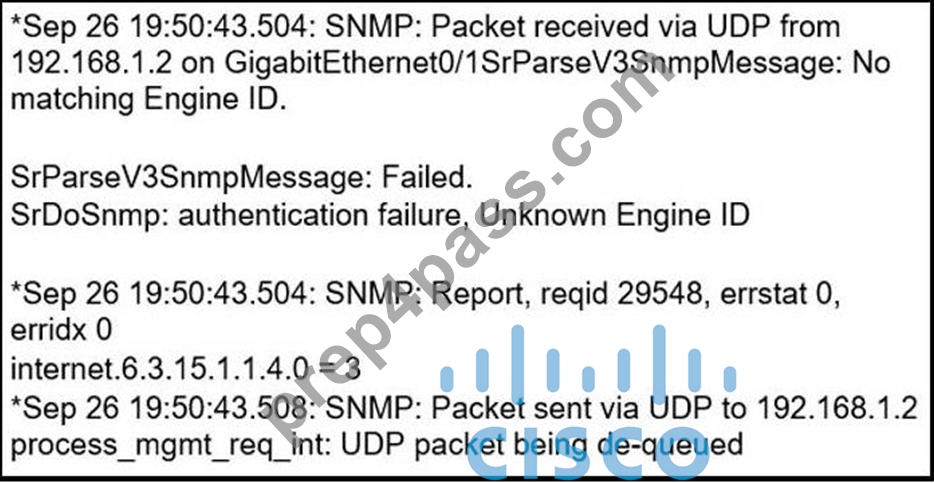
Which two commands provide the administrator with the information needed to resolve the issue? (Choose two.)
- A. debug snmp packet
- B. showsnmpv3 user
- C. debug snmpv3 engine-id
- D. debug snmp engine-id
- E. Show snmp user
Answer: A,E
Explanation:
There are 3 values in the SNMPv3 header that must match for the communication to take place: snmpEngineID, snmpEngineTime, snmpEngineBoots. The error received indicates a problem with the EngineID value: "authentication failure, Unknown Engine ID" To specify the Engine ID, we can use the command "show snmp user". The following example specifies the username as abcd with Engine ID: 00000009020000000C025808: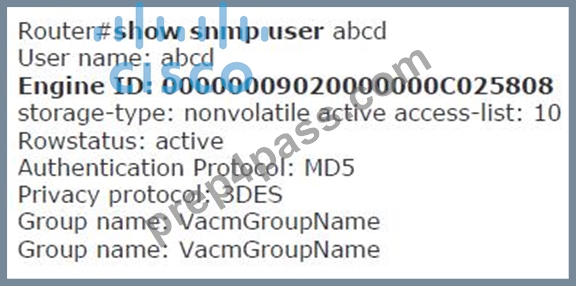
The "debug snmp packet" command displays all SNMP packets that are arriving and being replied to.
NEW QUESTION # 86
Refer to the exhibit.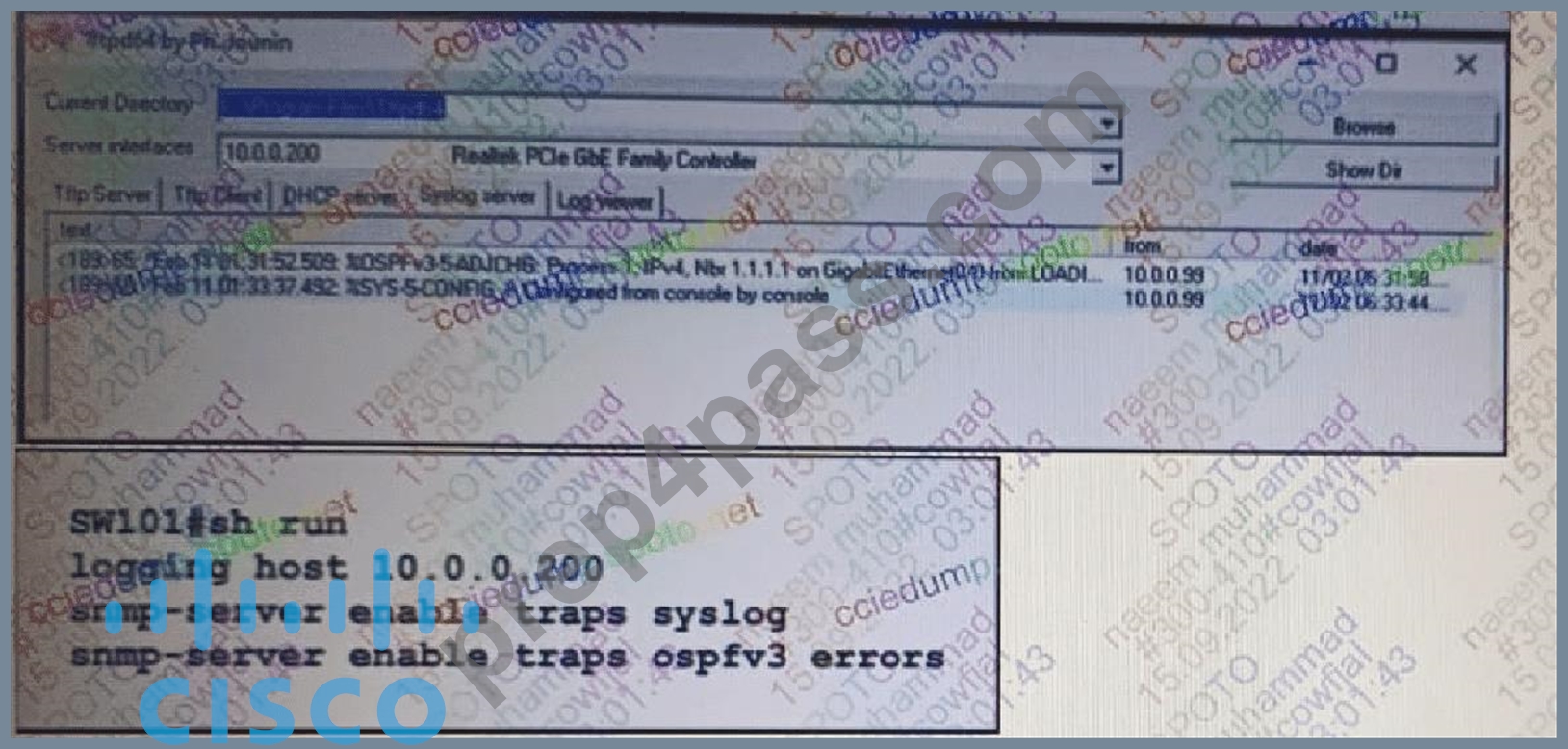
An engineer configures SW101 to send OSPFv3 interfaces state change messages to the server. However, only some OSPFv3 errors are being recorded. which organization resolves the ..?
- A. snmp-server enable traps ospfv3 state-change if-state-change
- B. snmp-server-enable traps ospfv3 state-change if-state-change neighbor-state-change
- C. snmp-server-enable traps ospfv3 state-change neighbor-state-change.
- D. snmp-server-enable traps ospfv3 state-change restart-status-change
Answer: B
NEW QUESTION # 87
Refer to the exhibit.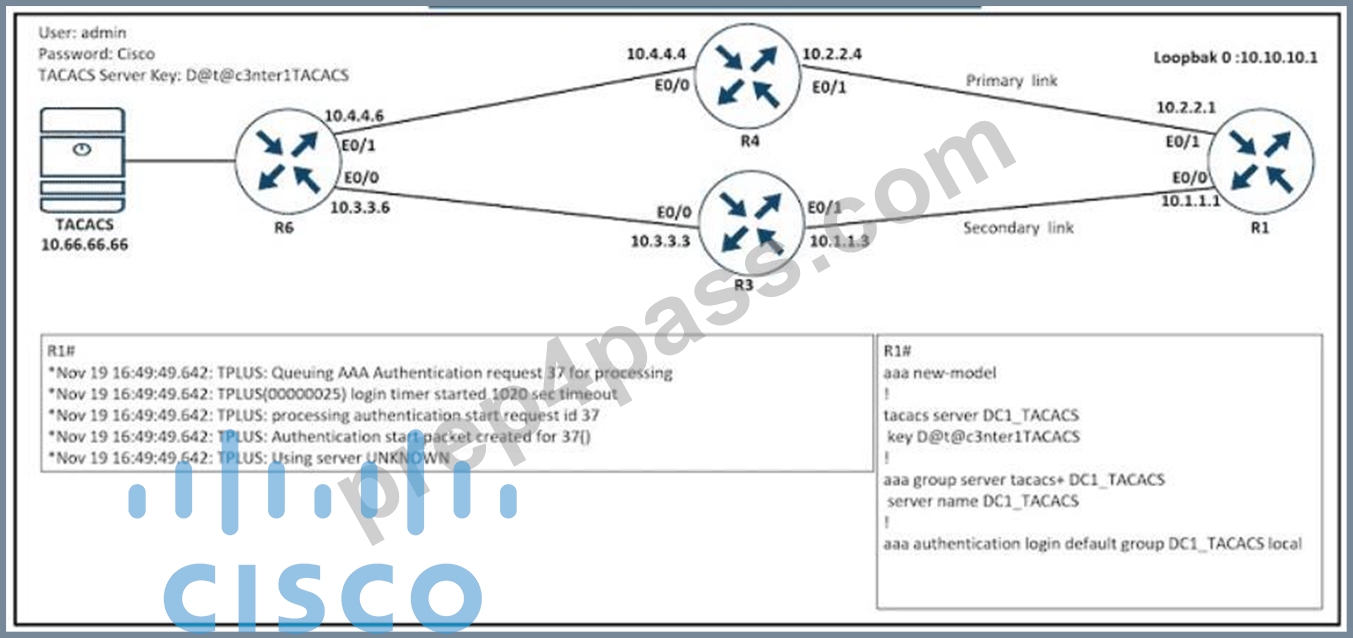
Refer to the exhibit R1 cannot authenticate via TACACS Which configuration resolves the issue?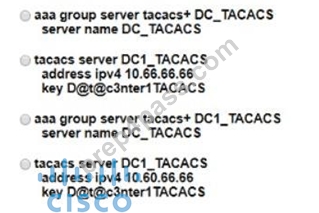
- A. Option B
- B. Option A
- C. Option D
- D. Option C
Answer: A
NEW QUESTION # 88
The network administrator configured R1 to authenticate Telnet connections based on Cisco ISE using TACACS+. ISE has been configured with an IP address of 192.168.1.5 and with a network device pointing toward R1(192.168.1.1) with a shared secret password of Cisco123.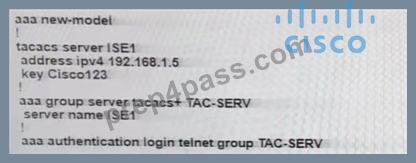
The administrator cannot authenticate to R1 based on ISE. Which configuration fixes the issue?
- A. line vty 0 4
login authentication TAC-SERV - B. ip tacacs-server host 192.168.1.5 key Cisco123
- C. line vty 0 4
login authentication telnet - D. tacacs-server host 192.168.1.5 key Cisco123
Answer: C
NEW QUESTION # 89
Drag and drop the IPv6 first hop security device roles from the left onto the corresponding descriptions on the right.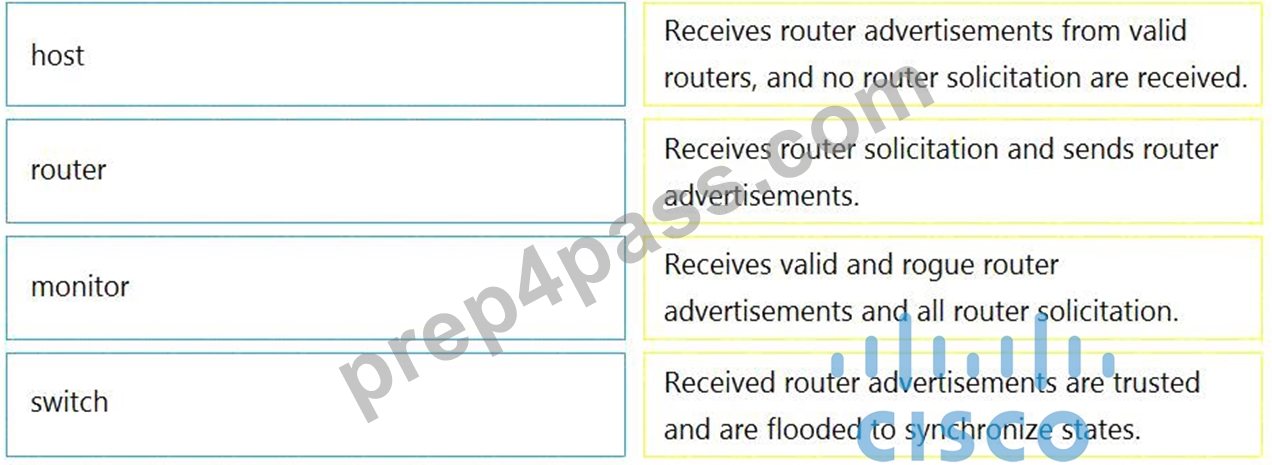
Answer:
Explanation: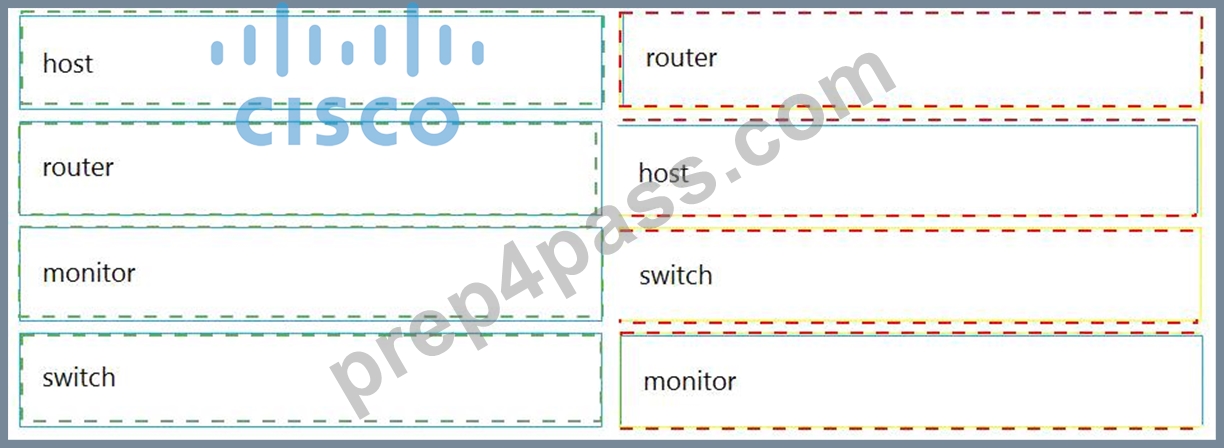
Explanation:
Graphical user interface, text, application, email Description automatically generated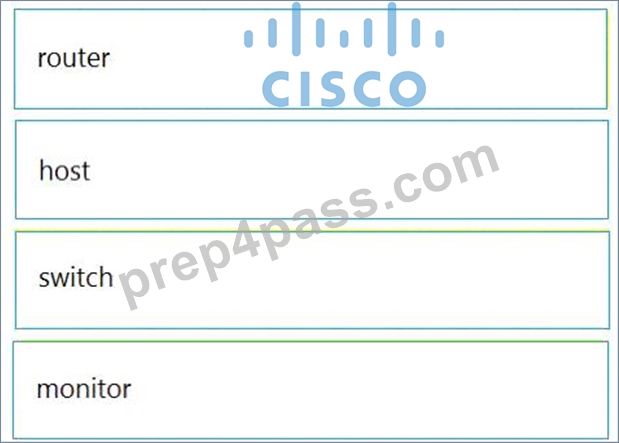
Reference:
https://www.cisco.com/c/en/us/td/docs/switches/datacenter/nexus9000/sw/7-x/security/configuration/guide/b_Ci
NEW QUESTION # 90
Refer to the exhibit.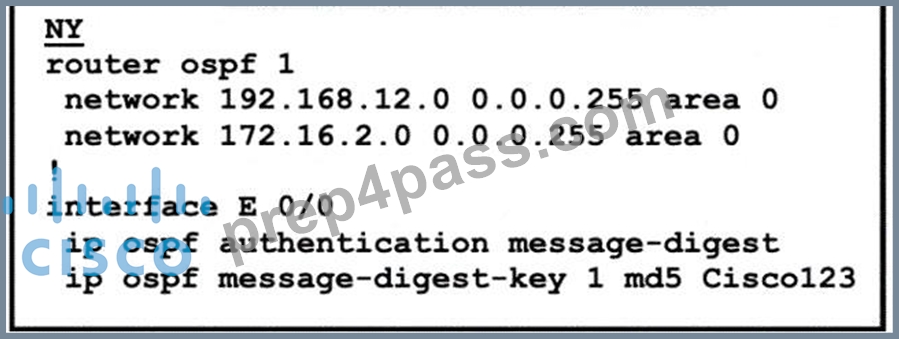
The neighbor relationship is not coming up Which two configurations bring the adjacency up? (Choose two)
- A. NYinterface E 0/0no ip ospf message-digest-key 1 md5 Cisco123ip ospf authentication-key Cisco123
- B. LAinterface E 0/0ip ospf authentication-key Cisco123
- C. LArouter ospf 1area 0 authentication message-digest
- D. LAinterface E 0/0ip ospf message-digest-key 1 md5 Cisco123
- E. NYrouter ospf 1area 0 authentication message-digest
Answer: C,D
Explanation:
The configuration on NY router is good for OSPF authentication. So we must enable OSPF authentication on LA router with the following commands:
router ospf 1
area 0 authentication message-digest
interface E0/0
ip ospf message-digest-key 1 md5 Cisco123
NEW QUESTION # 91
Refer to the exhibit.
R1 is connected with R2 via GigabitEthernet0/0, and R2 cannot ping R1. What action will fix the issue?
- A. Fix IP Event Dampening configured on the interface.
- B. Correct the IP SLA probe that failed.
- C. Fix route dampening configured on the router.
- D. Replace the SFP module because it is not supported.
Answer: A
Explanation:
NEW QUESTION # 92
Refer to the exhibit.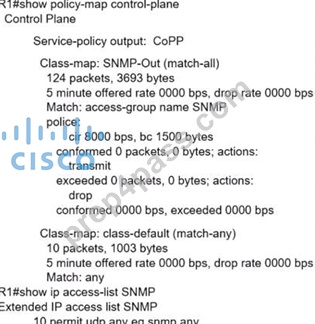
R1 is being monitored using SNMP and monitoring devices are getting only partial information. What action should be taken to resolve this issue?
- A. Modify the CoPP policy to increase the configured exceeded limit for SNMP.
- B. Modify the access list to include snmptrap.
- C. Modify the CoPP policy to increase the configured CIR limit for SNMP.
Answer: B
NEW QUESTION # 93
How is VPN routing information distributed in an MPLS network?
- A. It is established using VPN IPsec peers.
- B. It is controlled using of VPN target communities.
- C. It is controlled through the use of RD.
- D. The top level of the customer data packet directs it to the correct CE device
Answer: B
Explanation:
Route Targets (BGP extended communities) on PE routers dictate which VRFs import or export VPN routes, thereby controlling the distribution of VPN routing information over the MPLS backbone.
NEW QUESTION # 94
Refer to the exhibit.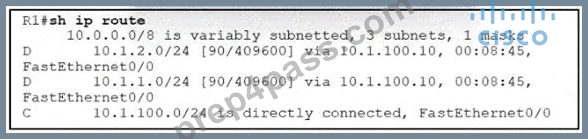
Although summarization is configured for R1 to receive 10.0.0.0/8. more specific routes are received by R1.
How should the 10.0.0.0/8 summary route be received from the neighbor, attached to R1 via Fast Ethernet0/0 interface?
- A. The summarization condition is not met Router 10 1 100.10 requires a route for 10 0.0.0/8 that points to null 0
- B. The summarization condition is not met. The network 10.1.100.0/24 should be changed to 172.16.0.0
/24. - C. R1 should configure the ip summary-address eigrp <AS number> 10.0.0.0 0.0.0.255 command under the Fast Ethernet 0/0 interface.
- D. R1 should configure the ip summary-address eigrp <AS number> 10.0.0.0.255.0.0.0 command under the Fast Ethernet 0/0 interface.
Answer: C
NEW QUESTION # 95
Refer to Exhibit: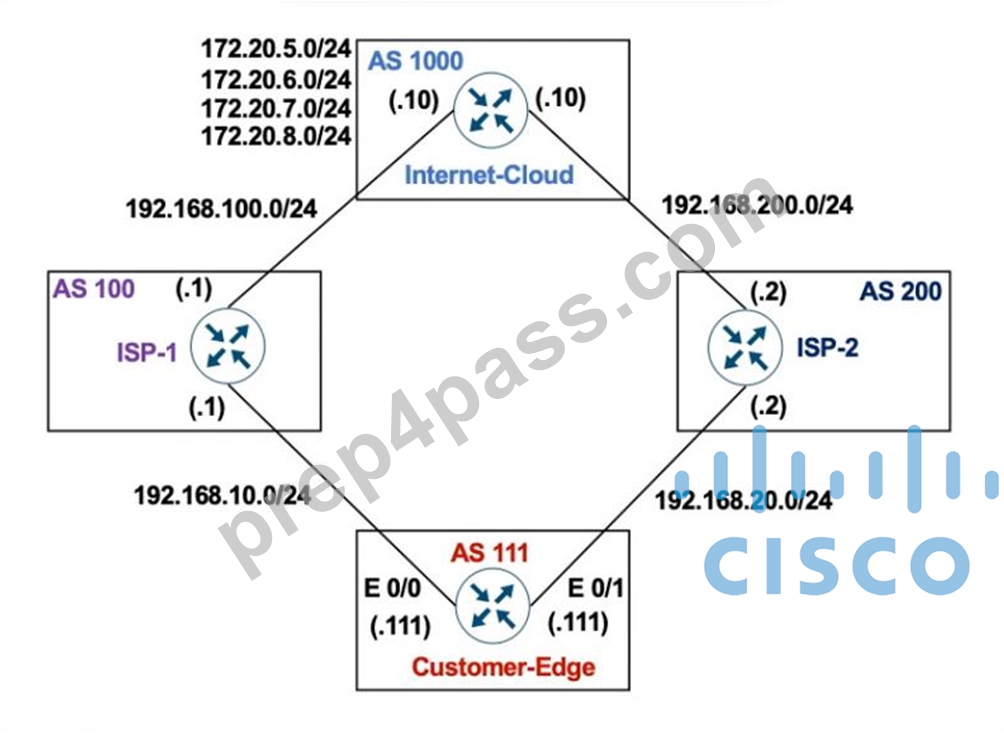
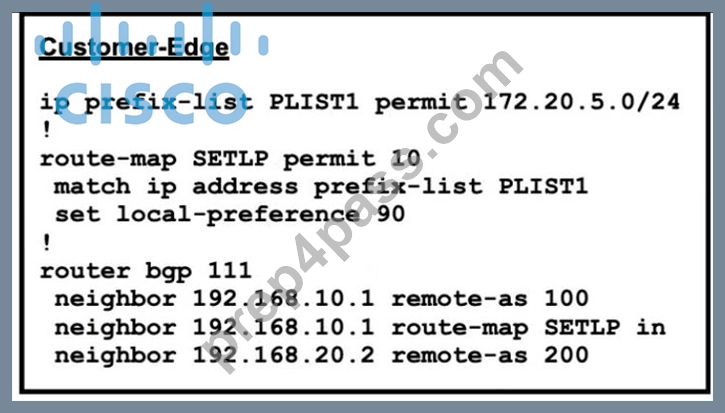
AS 111 wanted to use AS 200 as the preferred path for 172.20.5.0/24 and AS 100 as the backup. After the configuration, AS 100 is not used for any other routes. Which configuration resolves the issue?
- A. router bgp 111
no neighbor 192.168.10.1 route-map SETLP in
neighbor 192.168.10.1 route-map SETLP out - B. route-mmap SETLP permit 10
match ip address prefix-list PLIST1
set local-preference 99
route-map SETLP permit 20 - C. router bap 111
no neighbor 192.168.10.1 route-map SETLP in
neighbor 192.168.20.2 route-map SE TLP in - D. route-map SETLP permit 10
match ip address prefix-list PLIST1
set local-preference 110
route-map SETLP permit 20
Answer: B
Explanation:
There is an implicit deny all at the end of any route-map so all other traffic that does not match 172.20.5.0/24 would be dropped. Therefore we have to add a permitsequence at the end of the route-map to allow other traffic.
The default value of Local Preference is 100 and higher value is preferred so we have to set the local preference of AS100 lower than that of AS200.
NEW QUESTION # 96
Refer to the exhibit.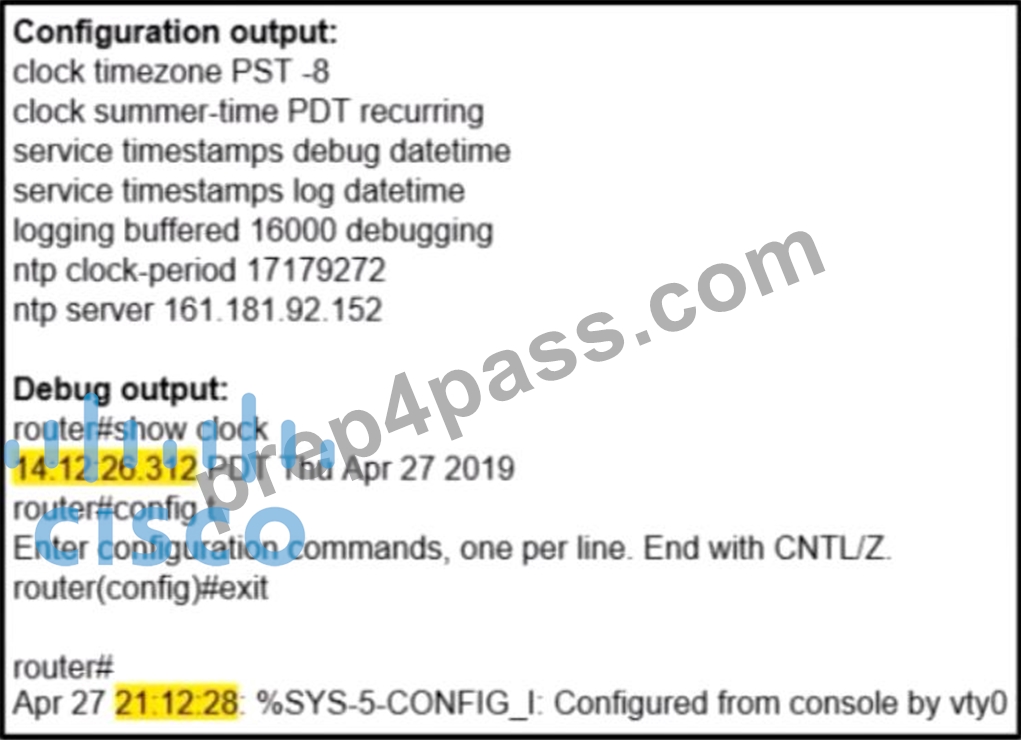
Refer to the exhibit. A network administrator configured NTP on a Cisco router to get synchronized time for system and logs from a unified time source The configuration did not work as desired Which service must be enabled to resolve the issue?
- A. Enter the service timestamps log datetime synchronize global command.
- B. Enter the service timestamps log datetime console global command.
- C. Enter the service timestamps log datetime clock-period global command
- D. Enter the service timestamps log datetime localtime global command.
Answer: D
Explanation:
If a router is configured to get the time from a Network Time Protocol (NTP) server, the times in the router's log entries may be different from the time on the systemclock if the [localtime] option is not in the service timestamps log command. To solve this issue, add the [localtime] option to the service timestamps log command. Thetimes should now be synchronized between the system clock and the log message timestamps.
NEW QUESTION # 97 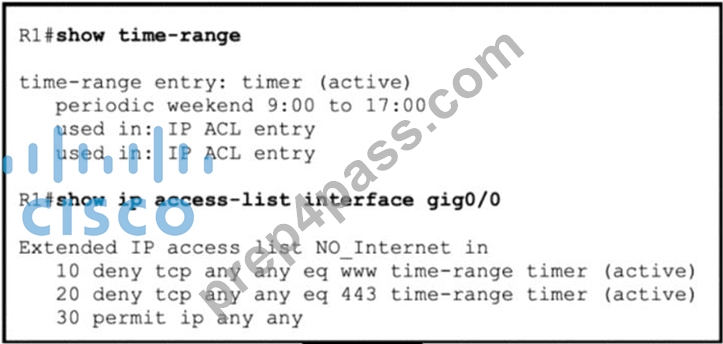
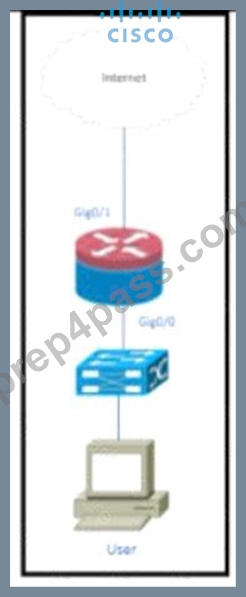
Refer to the exhibit. Users on a call center report that they cannot browse the internet on Saturdays during the afternoon. Which configuration resolves the issue?
- A.

- B.

- C.

- D.

Answer: D
NEW QUESTION # 98
Drag and drop the descriptions from the left onto the corresponding MPLS components on the right.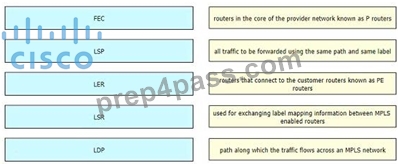
Answer:
Explanation: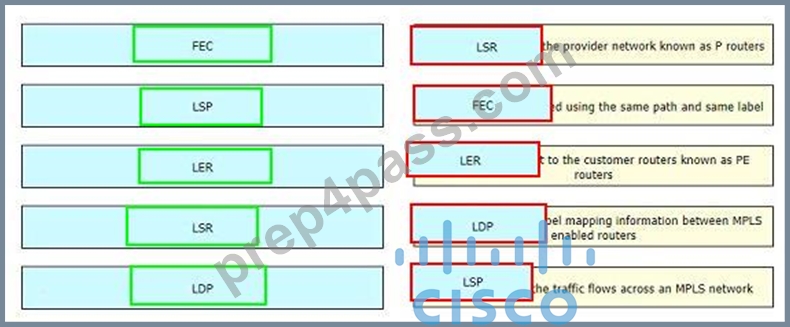
NEW QUESTION # 99 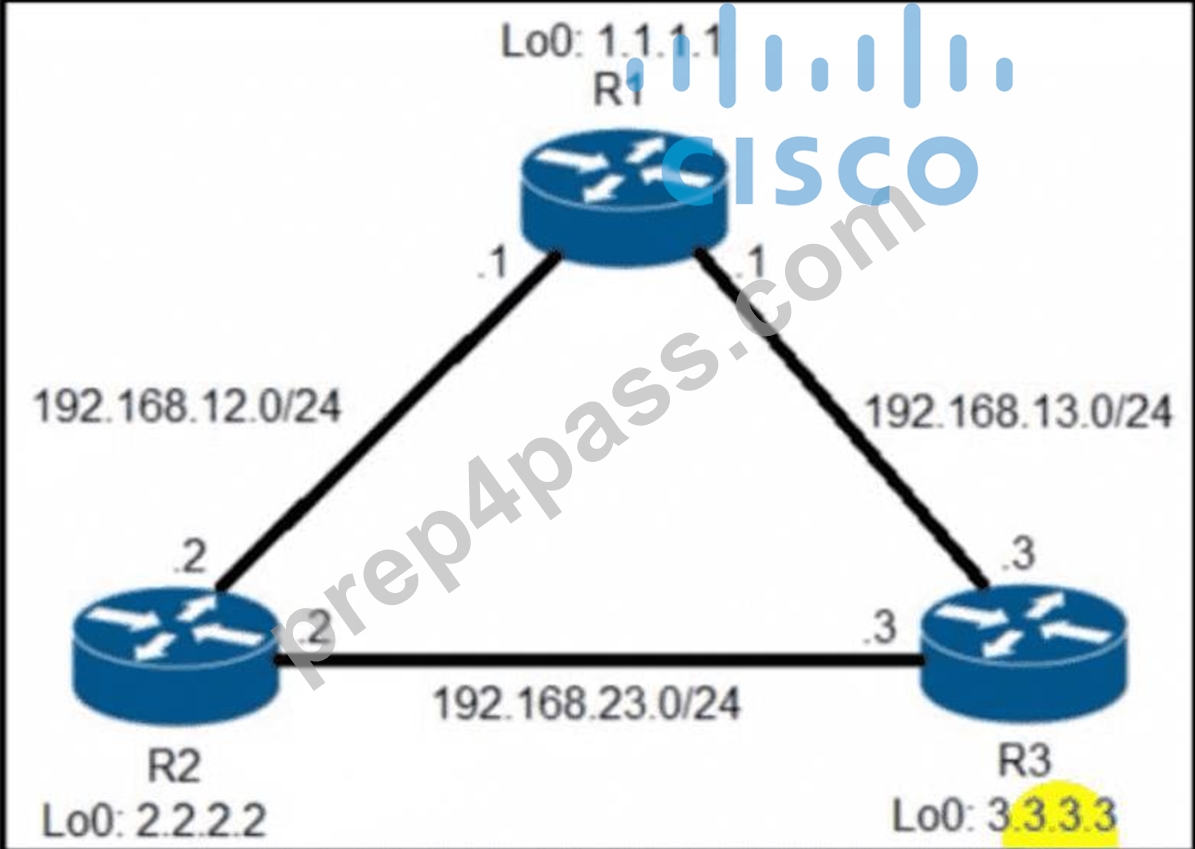
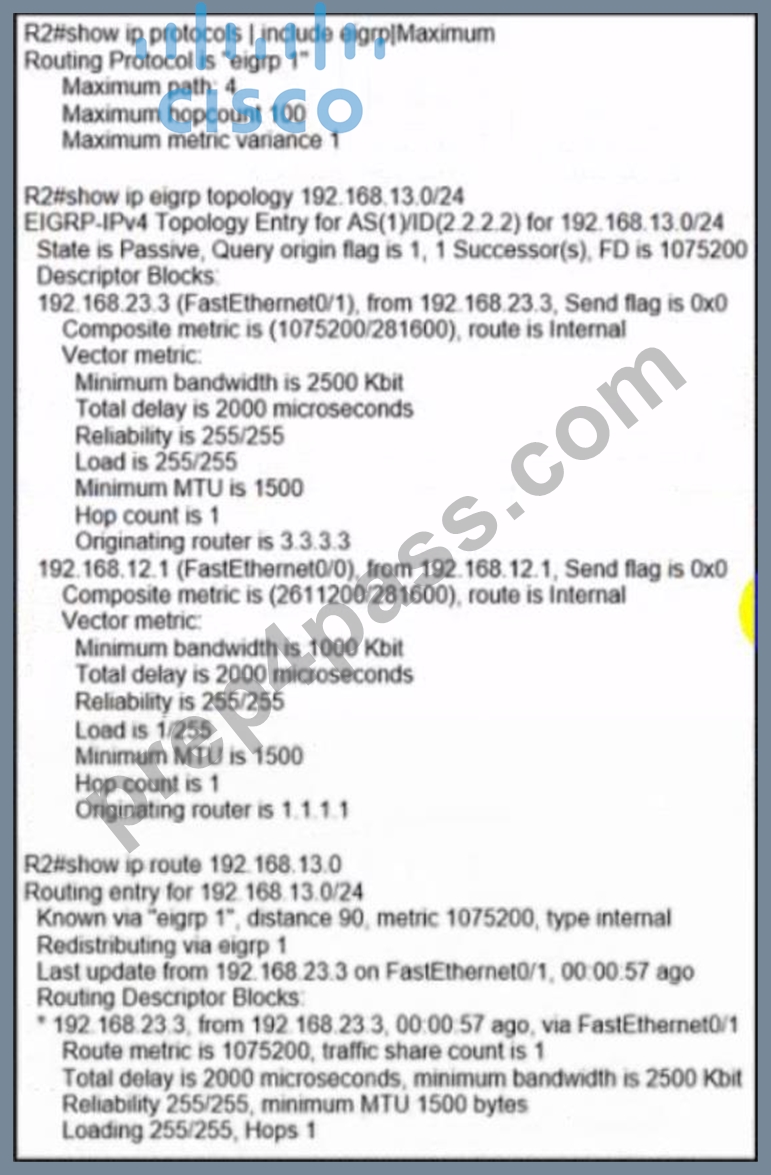
Refer to the exhibit. R2 has two paths to reach 192.168.13.0/24. but traffic is sent only through R3. Which action allows traffic to use both paths?
- A. Configure the variance 4 command under the EIGRP process on R2.
- B. Configure the variance 2 command under the EIGRP process on R2
- C. Configure the delay 1 command under interface FastEthernet0/0 on R2.
- D. Configure the bandwidth 2000 command under interface FastEthernet0/0 on R2.
Answer: A
Explanation:
From the output of the "show ip eigrp topology ..." command, we notice network 192.168.13.0/24 was learned via two routes:+ From 192.168.23.3 (R3) with FD = 1075200 and AD = 281600+ From 192.168.12.1 (R1) with FD = 2611200 and AD = 281600 From the output of the "show ip route ..." command, we learned that the best (and chosen) path is via
192.168.23.3 (R3).
To use both paths (called unequal cost load balancing) with EIGRP, the second path via R1 must satisfy the feasibility condition. The feasibility condition states that, theAdvertised Distance (AD) of a route must be lower than the feasible distance of the current successor route.
In this case, the second path satisfies the feasible condition as its AD (281600) is smaller than the FD (1075200) of the best path. Therefore we can configure loadbalancing with "variance" command.
In other words, EIGRP will install all paths with metric < variance * best_metric into the local routing table, provided that it meets the feasibility condition to preventrouting loop. Therefore we can calculate the variance
> metric / best_metric = 2611200 / 1075200 =2.4.
So with a variance greater than 2 (and must be an integer), we can load balance traffic to network 192.168.13.0
/24.
NEW QUESTION # 100
Refer to the exhibit.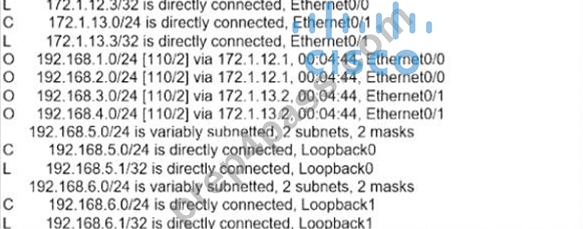
SanFrancisco and Boston routers are choosing slower links to reach each other despite the direct links being up Which configuration fixes the issue?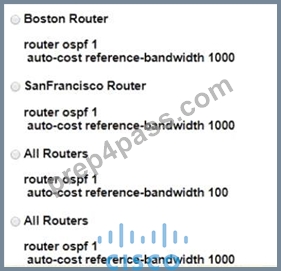
- A. Option B
- B. Option D
- C. Option A
- D. Option C
Answer: B
NEW QUESTION # 101
:579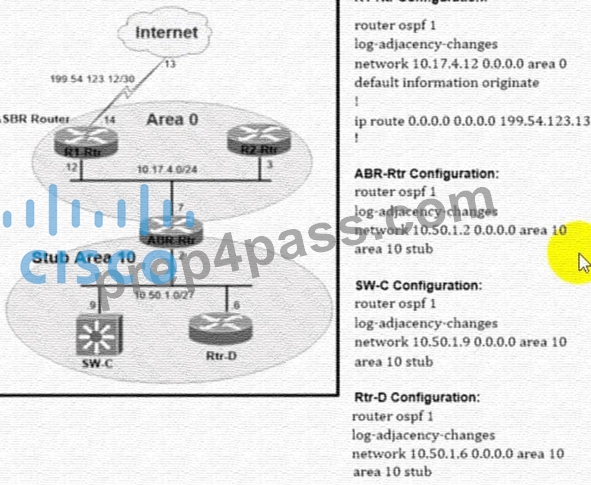
Refer to the exhibit. Router ABR-Rtr is not propagating the internet routes in OSPF area 10. which causes internet reachability problems in the area. Which action resolves the issue?
- A. ABR-Rtr must advertise the 0.0.0.0/0 default route in area 10.
- B. ABR-Rtr must configure the default-information originate always command.
- C. ABR-Rtr network type must be broadcast network.
- D. ABR-Rtr must configure the area 10 stub no-summary command.
Answer: A
NEW QUESTION # 102
Refer to the exhibit.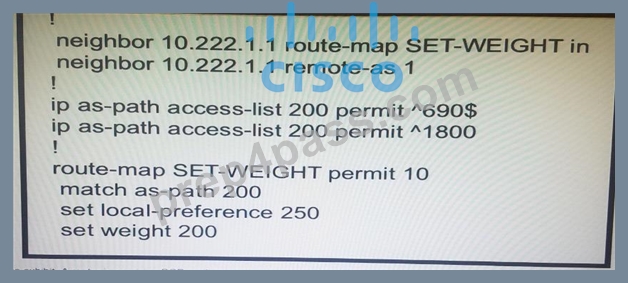
A router receiving BGP routing updates from multiple neighbors for routers in AS 690. What is the reason that the router still sends traffic that is destined to AS 690 to a neighbor other than 10.222.1.1?
- A. The local preference value should be set to the same value as the weight in the route map.
- B. The weight value in another neighbor statement is higher than 200.
- C. The route map is applied in the wrong direction.
- D. The local preference value in another neighbor statement is higher than 250.
Answer: C
NEW QUESTION # 103
......
300-410 Dumps - Pass Your Certification Exam: https://questionsfree.prep4pass.com/300-410_exam-braindumps.html
