

Valid NSE8_812 Test Answers & Fortinet NSE8_812 Exam PDF
Fortinet NSE8_812 Certification Real 2025 Mock Exam
Fortinet NSE8_812 (Fortinet NSE 8 - Written Exam) is a certification exam that is designed for the individuals who want to prove their skills and knowledge in network security. NSE8_812 exam is intended for the experienced network security professionals who have a deep understanding of the Fortinet security solutions and best practices. Passing NSE8_812 exam validates that the candidate has the skills and knowledge required to manage, configure and troubleshoot complex Fortinet network security solutions.
NEW QUESTION # 57
Which two methods are supported for importing user defined Lookup Table Data into the FortiSIEM? (Choose two.)
- A. FTP
- B. API
- C. Report
- D. SCP
Answer: B,C
Explanation:
FortiSIEM supports two methods for importing user defined Lookup Table Data:
Report: You can import lookup table data from a report. This is the most common method for importing lookup table data.
API: You can also import lookup table data using the FortiSIEM API. This is a more advanced method that allows you to import lookup table data programmatically.
FTP, SCP, and other file transfer protocols are not supported for importing lookup table data into FortiSIEM.
NEW QUESTION # 58
Refer to the exhibit showing FortiGate configurations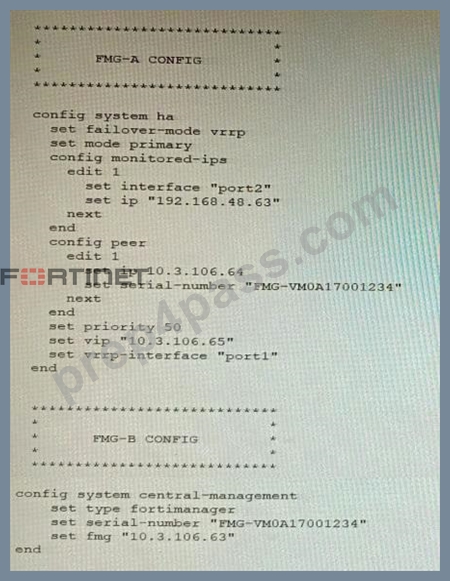
FortiManager VM high availability (HA) is not functioning as expected after being added to an existing deployment.
The administrator finds that VRRP HA mode is selected, but primary and secondary roles are greyed out in the GUI The managed devices never show online when FMG-B becomes primary, but they will show online whenever the FMG-A becomes primary.
What change will correct HA functionality in this scenario?
- A. Unset the primary and secondary roles in the FortiManager CLI configuration so VRRP will decide who is primary.
- B. Change the FortiManager IP address on the managed FortiGate to 10.3.106.65.
- C. Make the monitored IP to match on both FortiManager devices.
- D. Change the priority of FMG-A to be numerically lower for higher preference
Answer: B
Explanation:
https://community.fortinet.com/t5/FortiManager/Technical-Tip-FortiManager-VRRP-HA-configuration-in- Azure-Public/ta-p/267503https://community.fortinet.com/t5/FortiManager/Technical-Tip-FortiManager-HA- setup-and-troubleshooting/ta-p/222998
NEW QUESTION # 59
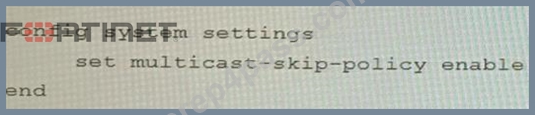
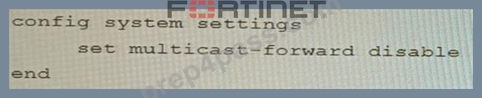
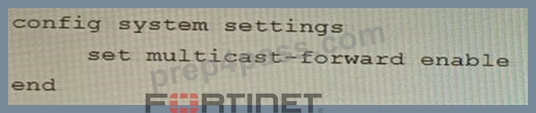
On a FortiGate Configured in Transparent mode, which configuration option allows you to control Multicast traffic passing through the?
- A.
- B.
- C.
- D.

Answer: B
Explanation:
To control multicast traffic passing through a FortiGate configured in transparent mode, you can use multicast policies. Multicast policies allow you to filter multicast traffic based on source and destination addresses, protocols, and interfaces. You can also apply security profiles to scan multicast traffic for threats and violations. References: https://docs.fortinet.com/document/fortigate/6.2.14/cookbook/968606/configuring-multicast-forwarding
NEW QUESTION # 60
A customer would like to improve the performance of a FortiGate VM running in an Azure D4s_v3 instance, but they already purchased a BYOL VM04 license.
Which two actions will improve performance the most without making a FortiGate license change? (Choose two.)
- A. Migrate the FortiGate to an Azure D8s_v3.
- B. Enable "Accelerated networking" on the Azure network interfaces.
- C. Migrate the FortiGate to an Azure F4s_v2.
- D. Enable SR-IOV on the FortiGate.
Answer: B,C
NEW QUESTION # 61
You are designing a setup where the FortiGate device is connected to two upstream ISPs using BGP. Part of the requirement is that you must be able to refresh the route advertisements manually without disconnecting the BGP neighborships.
Which feature must you enable on the BGP neighbors to accomplish this goal?
- A. Synchronization
- B. Deterministic-med
- C. Soft-reconfiguration
- D. Graceful-restart
Answer: C
Explanation:
The soft reconfigure is correct by elimination (FGTs all support BGP Refresh, so question is not worded correctly - to refresh routes in advertisements, there is no need to do manually anything, after the change is committed to config FGT will send BGP Refresh message to the peers to notify them of it. The same is true for Cisco and Juniper routers. The question should ask "when routing policy was changed" - then yes, reconfiguraiton is the way to notify BGP peers that BGP policy was changed.
NEW QUESTION # 62
Which two statements are correct on a FortiGate using the FortiGuard Outbreak Protection Service (VOS)? (Choose two.)
- A. If third-party AV database returns a match the scanned file is deemed to be malicious.
- B. The hash signatures are obtained from the FortiGuard Global Threat Intelligence database.
- C. The antivirus database queries FortiGuard with the hash of a scanned file
- D. The AV engine scan must be enabled to use the FortiGuard VOS feature
- E. The FortiGuard VOS can be used only with proxy-base policy inspections.
Answer: B,C
Explanation:
The FortiGuard Outbreak Prevention Service (VOS) is a feature that enhances the antivirus scanning capabilities of FortiGate by querying FortiGuard with the hash of a scanned file that is not found in the local antivirus database. If the hash matches a signature in the FortiGuard Global Threat Intelligence database, which contains information about known malware and zero-day threats, the file is deemed to be malicious and blocked by FortiGate. The VOS feature can be used with both proxy-based and flow-based policy inspections, and does not require the AV engine scan to be enabled. Reference: https://docs.fortinet.com/document/fortigate/6.2.14/cookbook/968606/outbreak-prevention-service
NEW QUESTION # 63
Wh.ch feature must you enable on the BGP neighbors to accomplish this goal?
- A. Graceful-restart
- B. Synchronization
- C. Soft-reconfiguration
- D. Deterministic-med
Answer: A
Explanation:
Graceful-restart is a feature that allows BGP neighbors to maintain their routing information during a BGP restart or failover event, without disrupting traffic forwarding or causing route flaps. Graceful-restart works by allowing a BGP speaker (the restarting router) to notify its neighbors (the helper routers) that it is about to restart or failover, and request them to preserve their routing information and forwarding state for a certain period of time (the restart time). The helper routers then mark the routes learned from the restarting router as stale, but keep them in their routing table and continue forwarding traffic based on them until they receive an end-of-RIB marker from the restarting router or until the restart time expires. This way, graceful-restart can minimize traffic disruption and routing instability during a BGP restart or failover event. Reference: https://docs.fortinet.com/document/fortigate/7.0.0/cookbook/19662/bgp-graceful-restart
NEW QUESTION # 64
You are running a diagnose command continuously as traffic flows through a platform with NP6 and you obtain the following output: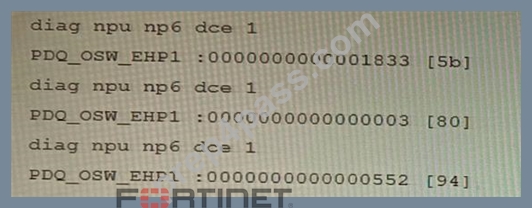
Given the information shown in the output, which two statements are true? (Choose two.)
- A. Enable HPE shaper for the NP6 will change the output
- B. There are packet drops at the XAUI.
- C. The output is showing a packet descriptor queue accumulated counter
- D. Host-shortcut mode is enabled.
- E. Enabling bandwidth control between the ISF and the NP will change the output
Answer: B,C
Explanation:
The diagnose command shown in the output is used to display information about NP6 packet descriptor queues. The output shows that there are 16 NP6 units in total, and each unit has four XAUI ports (XA0-XA3). The output also shows that there are some non-zero values in the columns PDQ ACCU (packet descriptor queue accumulated counter) and PDQ DROP (packet descriptor queue drop counter). These values indicate that there are some packet descriptor queues that have reached their maximum capacity and have dropped some packets at the XAUI ports. This could be caused by congestion or misconfiguration of the XAUI ports or the ISF (Internal Switch Fabric). Reference: https://docs.fortinet.com/document/fortigate/7.0.0/cli-reference/19662/diagnose-np6-pdq
NEW QUESTION # 65
SD-WAN is configured on a FortiGate. You notice that when one of the internet links has high latency the time to resolve names using DNS from FortiGate is very high.
You must ensure that the FortiGate DNS resolution times are as low as possible with the least amount of work.
What should you configure?
- A. Configure two DNS servers and use DNS servers recommended by the two internet providers.
- B. Configure local out traffic to use the outgoing interface based on SD-WAN rules with the interface IP and configure an SD-WAN rule to the DNS server.
- C. Configure local out traffic to use the outgoing interface based on SD-WAN rules with a manual defined IP associated to a loopback interface and configure an SD-WAN rule from the loopback to the DNS server.
- D. Configure an SD-WAN rule to the DNS server and use the FortiGate interface IPs in the source address.
Answer: B
Explanation:
SD-WAN is a feature that allows users to optimize network performance and reliability by using multiple WAN links and applying rules based on various criteria, such as latency, jitter, packet loss, etc. One way to ensure that the FortiGate DNS resolution times are as low as possible with the least amount of work is to configure local out traffic to use the outgoing interface based on SD-WAN rules with the interface IP and configure an SD-WAN rule to the DNS server. This means that the FortiGate will use the best WAN link available to send DNS queries to the DNS server according to the SD-WAN rule, and use its own interface IP as the source address. This avoids NAT issues and ensures optimal DNS performance. Reference: https://docs.fortinet.com/document/fortigate/7.0.0/sd-wan/19662/sd-wan
NEW QUESTION # 66
A customer with a FortiDDoS 200F protecting their fibre optic internet connection from incoming traffic sees that all the traffic was dropped by the device even though they were not under a DoS attack. The traffic flow was restored after it was rebooted using the GUI. Which two options will prevent this situation in the future? (Choose two)
- A. Replace with a FortiDDoS 1500F
- B. Change the Adaptive Mode.
- C. Create an HA setup with a second FortiDDoS 200F
- D. Move the internet connection from the SFP interfaces to the LC interfaces
Answer: B,C
Explanation:
To prevent the situation where all the traffic was dropped by the FortiDDoS 200F even though there was no DoS attack, the following options can be considered:
Change the Adaptive Mode. The Adaptive Mode is a feature that allows the FortiDDoS 200F to automatically adjust its detection and prevention thresholds based on the traffic patterns and behavior. However, if the Adaptive Mode is not configured properly, it may cause false positives and drop legitimate traffic. Therefore, changing the Adaptive Mode settings or disabling it may help to avoid this situation.
Create an HA setup with a second FortiDDoS 200F. The HA setup is a feature that allows two FortiDDoS 200F devices to work together as a cluster and provide redundancy and load balancing. If one device fails or drops traffic, the other device can take over and continue to protect the network. Therefore, creating an HA setup with a second FortiDDoS 200F may help to avoid this situation. Reference: https://docs.fortinet.com/document/fortiddos-f/6.2.0/handbook/380639/understanding-fortiddos-adaptive-mode https://docs.fortinet.com/document/fortiddos-f/6.2.0/handbook/380639/configuring-fortiddos-ha
NEW QUESTION # 67
Refer to the exhibit.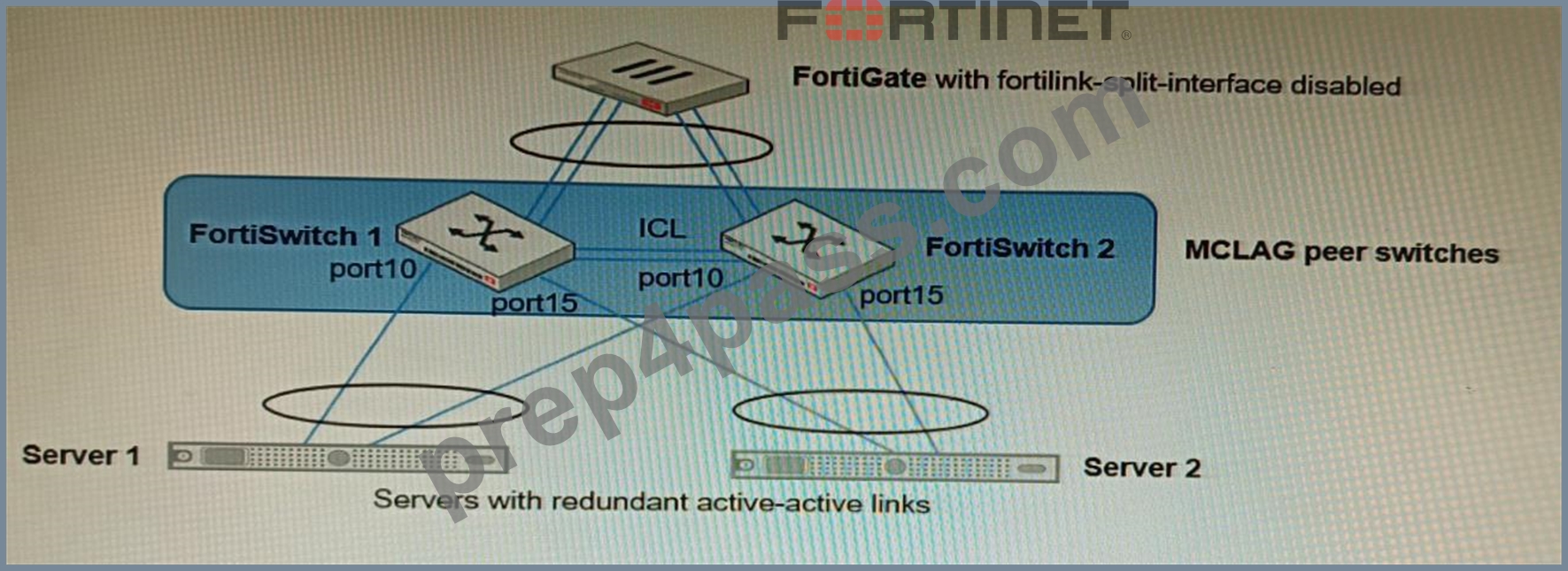
You have been tasked with replacing the managed switch Forti Switch 2 shown in the topology.
Which two actions are correct regarding the replacement process? (Choose two.)
- A. After replacing the FortiSwitch unit, the automatically created trunk name does not change
- B. MCLAG-ICL will be automatically reconfigured once the new switch is connected to the FortiGate.
- C. CLAG-ICL needs to be manually reconfigured once the new switch is connected to the FortiGate
- D. After replacing the FortiSwitch unit, the automatically created trunk name changes.
Answer: A,C
Explanation:
A is correct because the automatically created trunk name is based on the MAC address of the FortiSwitch unit. When the FortiSwitch unit is replaced, the MAC address will change, but the trunk name will not change.
B is correct because CLAG-ICL is a manually configured link aggregation group. When the FortiSwitch unit is replaced, the CLAG-ICL configuration will need to be manually reconfigured on the new FortiSwitch unit.
The other options are incorrect. Option C is incorrect because the automatically created trunk name does not change when the FortiSwitch unit is replaced. Option D is incorrect because MCLAG-ICL is a manually configured link aggregation group and will not be automatically reconfigured when the FortiSwitch unit is replaced.
References:
Configuring link aggregation on FortiSwitches | FortiSwitch / FortiOS 7.0.4 - Fortinet Document Library Managing FortiLink | FortiGate / FortiOS 7.0.4 - Fortinet Document Library
NEW QUESTION # 68
Refer to the exhibits.
Exhibit A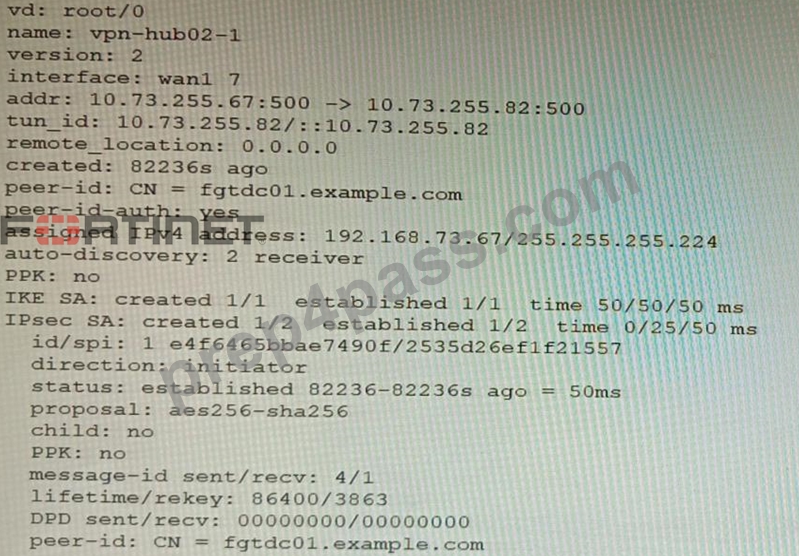
Exhibit B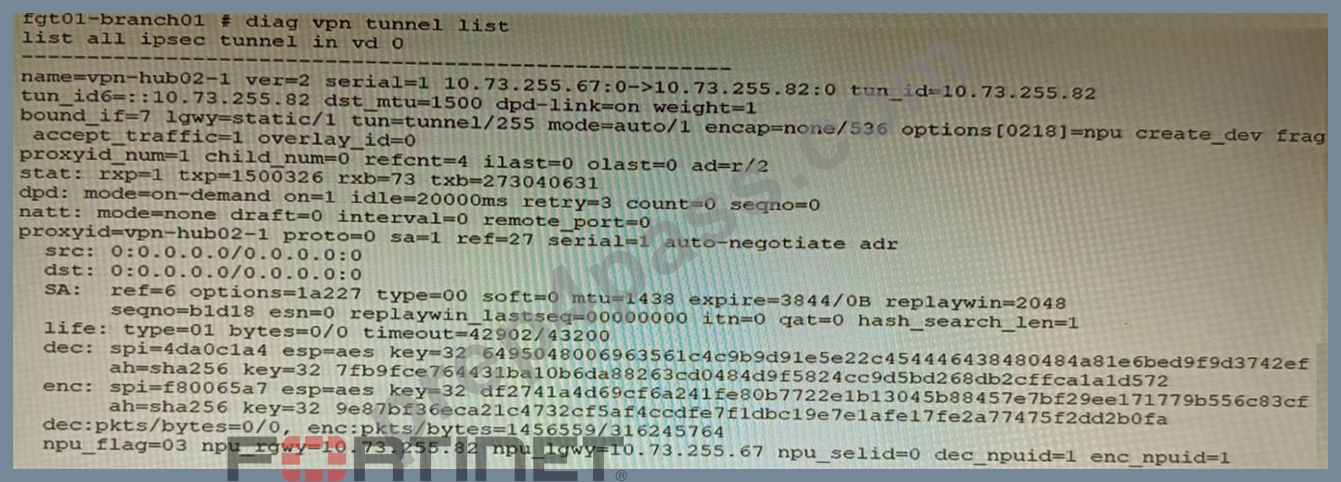
Exhibit C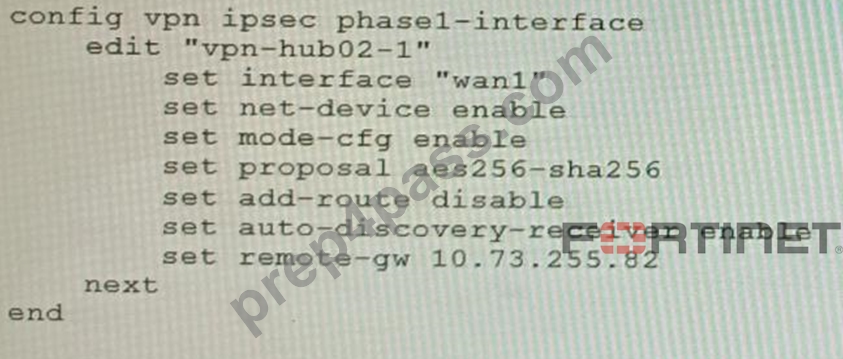
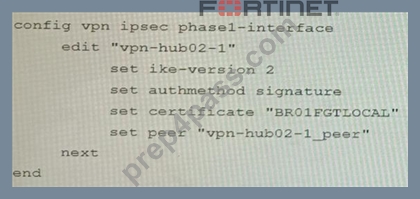
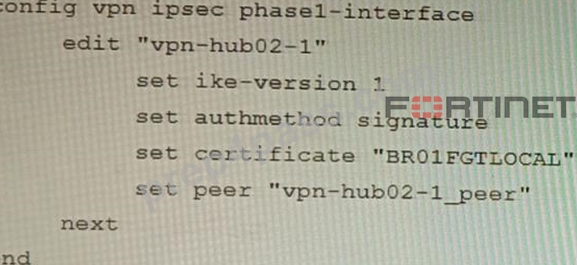
A customer is trying to set up a VPN with a FortiGate, but they do not have a backup of the configuration. Output during a troubleshooting session is shown in the exhibits A and B and a baseline VPN configuration is shown in Exhibit C Referring to the exhibits, which configuration will restore VPN connectivity?
- A.
- B.
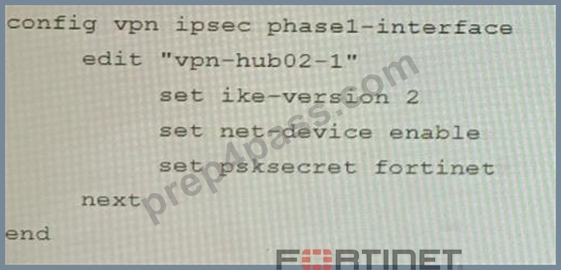
- C.
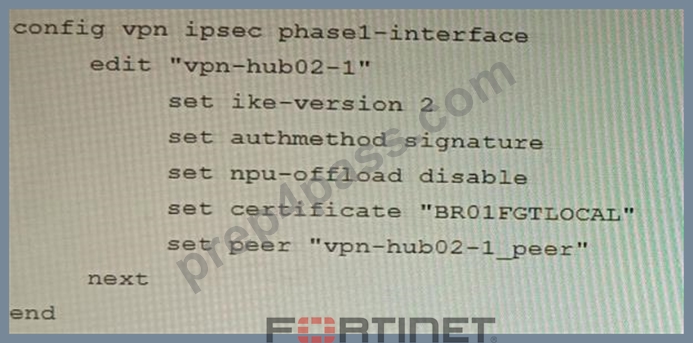
- D.
Answer: B
Explanation:
The VPN configuration shown in Exhibit C is a baseline VPN configuration that uses IKEv2 with pre-shared keys and AES256 encryption for both IKE and ESP phases. However, this configuration does not match the output shown in Exhibit A and B, which indicate that IKEv1 is used with RSA signatures and AES128 encryption for both IKE and ESP phases. Therefore, to restore VPN connectivity, the configuration needs to be modified to match these parameters. Option B shows the correct configuration that matches these parameters. Option A is incorrect because it still uses IKEv2 instead of IKEv1. Option C is incorrect because it still uses pre-shared keys instead of RSA signatures. Option D is incorrect because it still uses AES256 encryption instead of AES128 encryption. Reference: https://docs.fortinet.com/document/fortigate/7.0.0/cookbook/19662/ipsec-vpn-with-forticlient
NEW QUESTION # 69
Which two statements are correct on a FortiGate using the FortiGuard Outbreak Protection Service (VOS)?
(Choose two.)
- A. If third-party AV database returns a match the scanned file is deemed to be malicious.
- B. The hash signatures are obtained from the FortiGuard Global Threat Intelligence database.
- C. The antivirus database queries FortiGuard with the hash of a scanned file
- D. The AV engine scan must be enabled to use the FortiGuard VOS feature
- E. The FortiGuard VOS can be used only with proxy-base policy inspections.
Answer: B,C
Explanation:
* C. The antivirus database queries FortiGuard with the hash of a scanned file. This is how the FortiGuard VOS service works. The FortiGate queries FortiGuardwith the hash of a scanned file, and FortiGuard returns a list of known malware signatures that match the hash.
* E. The hash signatures are obtained from the FortiGuard Global Threat Intelligence database. This is where the FortiGuard VOS service gets its hash signatures from. The FortiGuard Global Threat Intelligence database is updated regularly with new malware signatures.
https://docs.fortinet.com/document/fortigate/7.4.1/administration-guide/889364/fortiguard-outbreak- prevention
NEW QUESTION # 70
An automation stitch was configured using an incoming webhook as the trigger named 'my_incoming_webhook'. The action is configured to execute the CLI Script shown: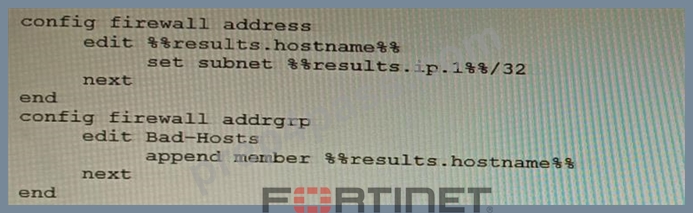
- A.

- B.

- C.

- D.

Answer: D
Explanation:
To execute the CLI script shown using an incoming webhook as the trigger, the correct syntax for the curl command is: curl -X POST -H "Content-Type: application/json" -d '{"trigger_name":"my_incoming_webhook"}' https://fortisoar.example.com/api/v1/trigger This command will send a POST request to the FortiSOAR API endpoint with the trigger name and the content type as JSON. The FortiSOAR API will then execute the automation stitch that matches the trigger name and run the CLI script on the FortiGate device. Reference: https://docs.fortinet.com/document/fortisoar/7.0.0/administration-guide/103440/automation-stitches https://docs.fortinet.com/document/fortisoar/7.0.0/administration-guide/103441/incoming-webhook
NEW QUESTION # 71
Refer to the exhibit.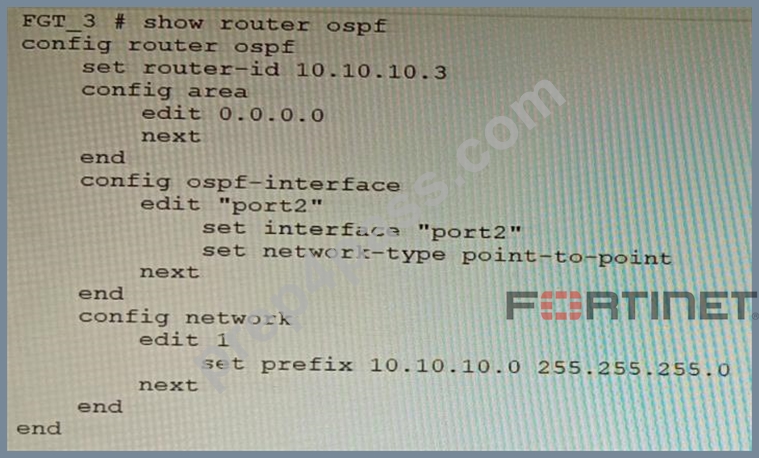
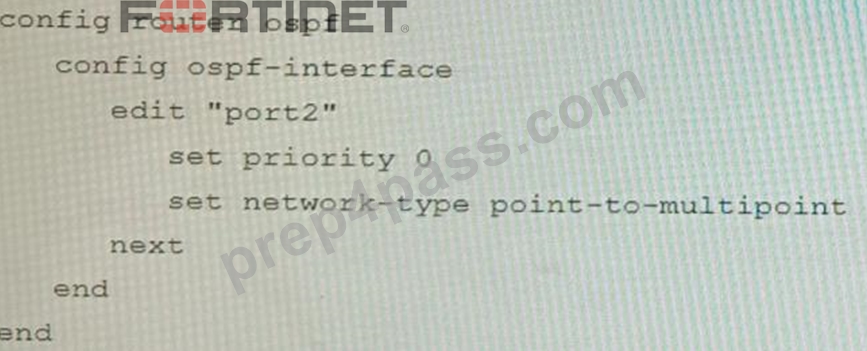
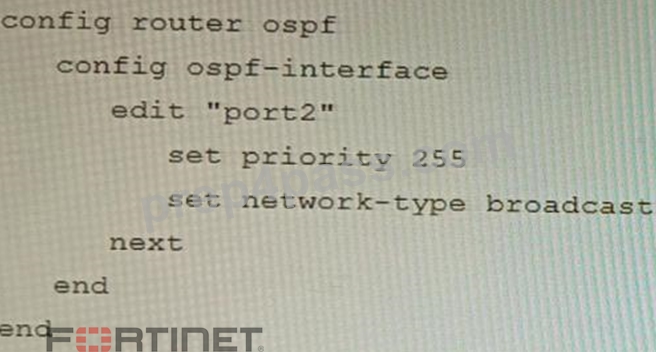
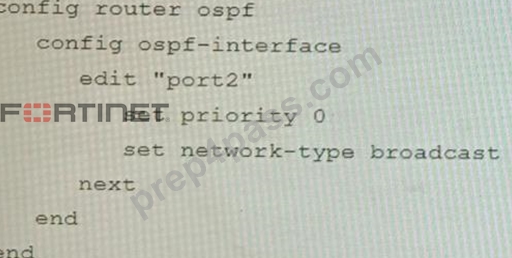
You are operating an internal network with multiple OSPF routers on the same LAN segment. FGT_3 needs to be added to the OSPF network and has the configuration shown in the exhibit. FGT_3 is not establishing any OSPF connection.
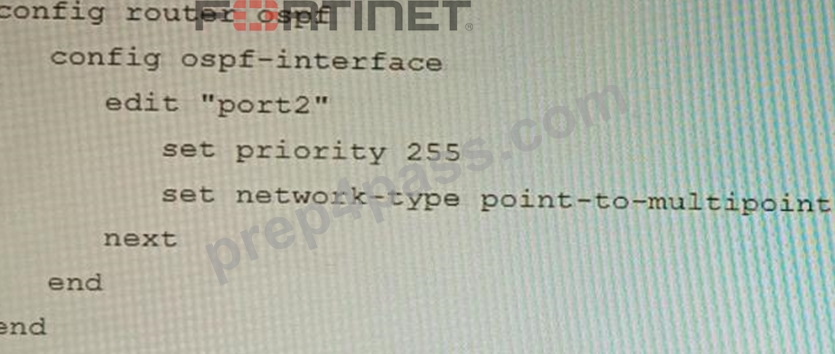
What needs to be changed to the configuration to make sure FGT_3 will establish OSPF neighbors without affecting the DR/BDR election?
- A.
- B.
- C.
- D.
Answer: D
Explanation:
The OSPF configuration shown in the exhibit is using the default priority value of 1 for the interface port1. This means that FGT_3 will participate in the DR/BDR election process with the other OSPF routers on the same LAN segment. However, this is not desirable because FGT_3 is a new device that needs to be added to the OSPF network without affecting the existing DR/BDR election. Therefore, to make sure FGT_3 will establish OSPF neighbors without affecting the DR/BDR election, the priority value of the interface port1 should be changed to 0. This will prevent FGT_3 from becoming a DR or BDR and allow it to form OSPF adjacencies with the current DR and BDR. Option B shows the correct configuration that changes the priority value to 0. Option A is incorrect because it does not change the priority value. Option C is incorrect because it changes the network type to point-to-point, which is not suitable for a LAN segment with multiple OSPF routers. Option D is incorrect because it changes the area ID to 0.0.0.1, which does not match the area ID of the other OSPF routers on the same LAN segment. References: https://docs.fortinet.com/document/fortigate/7.0.0/administration-guide/358640/basic-ospf-example
NEW QUESTION # 72
Refer to the exhibit.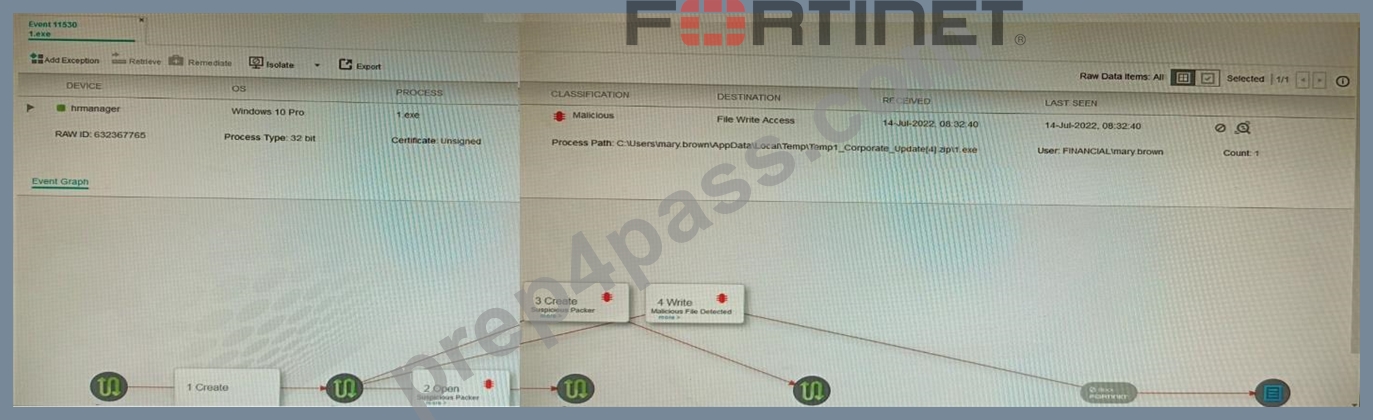
The exhibit shows the forensics analysis of an event detected by the FortiEDR core In this scenario, which statement is correct regarding the threat?
- A. This is an exfiltration attack and has not been stopped by FortiEDR
- B. This is a ransomware attack and has not been stopped by FortiEDR.
- C. This is a ransomware attack and has been stopped by FortiEDR
- D. This is an exfiltration attack and has been stopped by FortiEDR.
Answer: A
Explanation:
The exhibit shows that the FortiEDR core has detected an exfiltration attack. The attack is attempting to copy files from the device to an external location. The FortiEDR core has blocked the attack, and the files have not been exfiltrated.
The exhibit also shows that the attack is using the Cobalt Strike beacon. Cobalt Strike is a penetration testing tool that can be used for both legitimate and malicious purposes. In this case, the Cobalt Strike beacon is being used to exfiltrate files from the device.
The other options are incorrect. Option A is incorrect because the attack has not been stopped. Option C is incorrect because the attack is not a ransomware attack. Option D is incorrect because the FortiEDR core has not stopped the attack.
References:
FortiEDR Forensics: https://docs.fortinet.com/document/fortiedr/6.0.0/administration-guide/733983/forensics Cobalt Strike: https://www.cobaltstrike.com/
NEW QUESTION # 73
Refer to the exhibit, which shows a Branch1 configuration and routing table.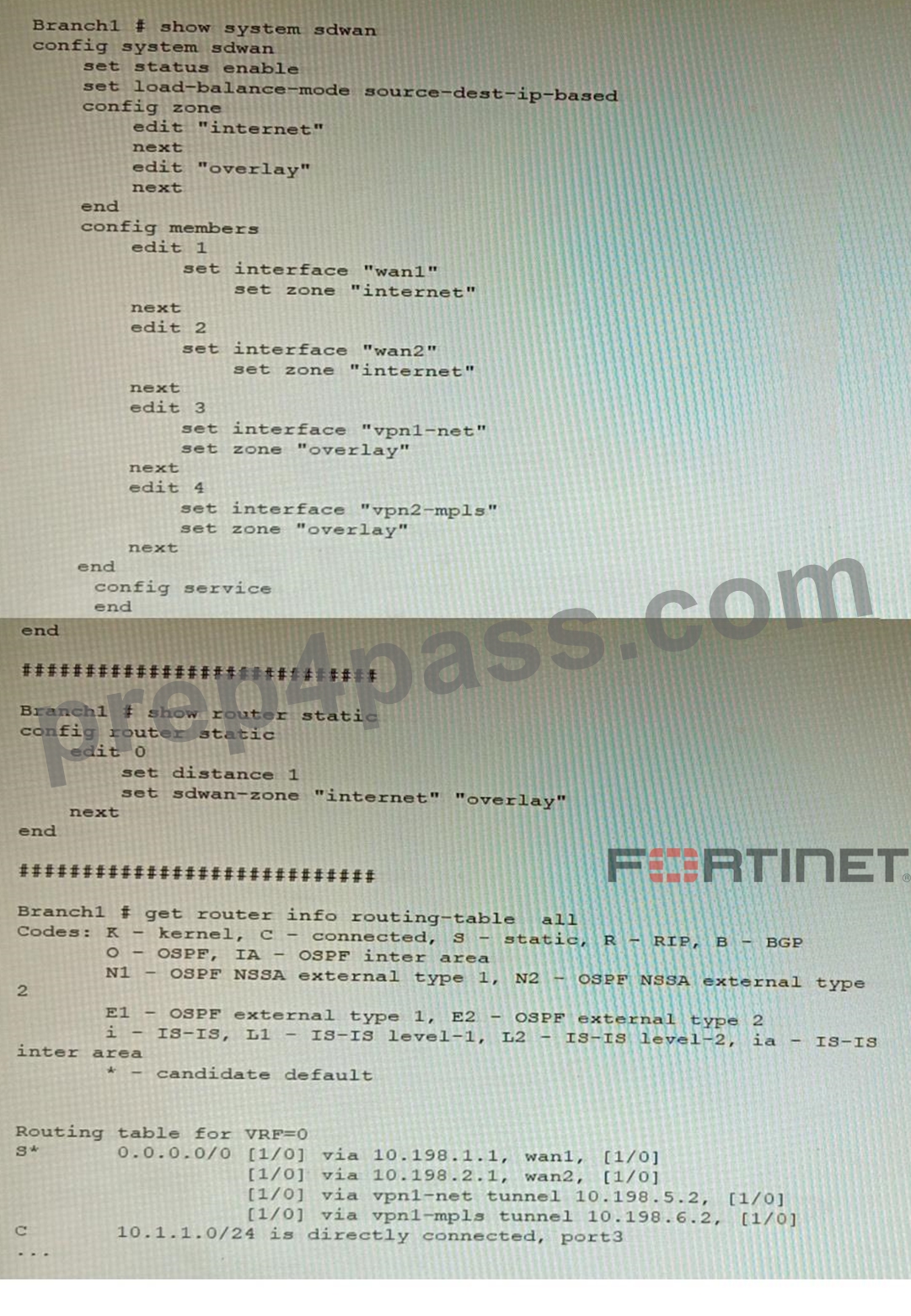
In the SD-WAN implicit rule, you do not want the traffic load balance for the overlay interface when all members are available.
In this scenario, which configuration change will meet this requirement?
- A. Configure the cost in each overlay member to 10.
- B. Configure the priority in each overlay member to 10.
- C. Create a new static route with the internet sdwan-zone only
- D. Change the load-balance-mode to source-ip-based.
Answer: B
Explanation:
The default load balancing mode for the SD-WAN implicit rule is source IP based. This means that traffic will be load balanced evenly between the overlay members, regardless of the member's priority.
To prevent traffic from being load balanced, you can configure the priority of each overlay member to 10. This will make the member ineligible for load balancing.
The other options are not correct. Changing the load balancing mode to source-IP based will still result in traffic being load balanced. Creating a new static route with the internet sdwan-zone only will not affect the load balancing of the overlay interface. Configuring the cost in each overlay member to 10 will also not affect the load balancing, as the cost is only used when the implicit rule cannot find a match for the destination IP address.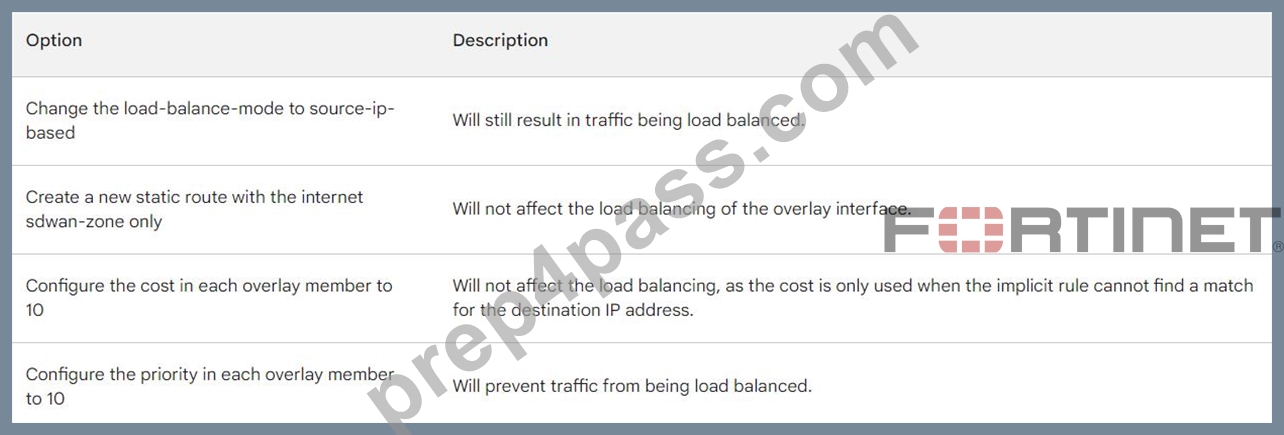
NEW QUESTION # 74
Refer to the exhibit.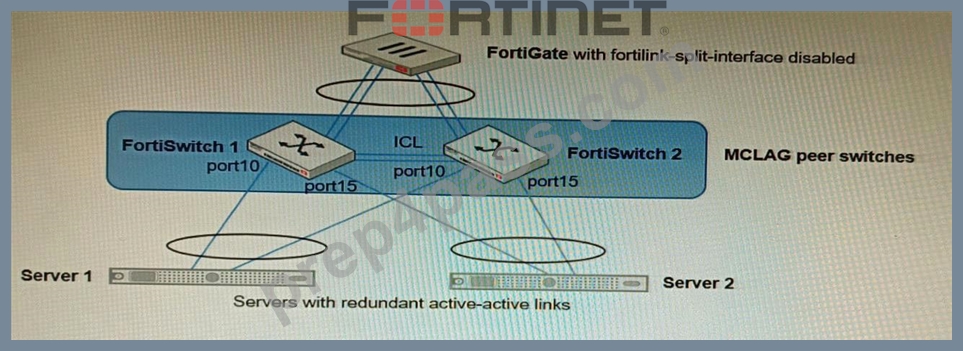
You have been tasked with replacing the managed switch Forti Switch 2 shown in the topology.
Which two actions are correct regarding the replacement process? (Choose two.)
- A. After replacing the FortiSwitch unit, the automatically created trunk name does not change
- B. MCLAG-ICL will be automatically reconfigured once the new switch is connected to the FortiGate.
- C. CLAG-ICL needs to be manually reconfigured once the new switch is connected to the FortiGate
- D. After replacing the FortiSwitch unit, the automatically created trunk name changes.
Answer: A,C
Explanation:
* A is correct because the automatically created trunk name is based on the MAC address of the FortiSwitch unit. When the FortiSwitch unit is replaced, the MAC address will change, but the trunk name will not change.
* B is correct because CLAG-ICL is a manually configured link aggregation group. When the FortiSwitch unit is replaced, the CLAG-ICL configuration will need to be manually reconfigured on the new FortiSwitch unit.
The other options are incorrect. Option C is incorrect because the automatically created trunk name does not change when the FortiSwitch unit is replaced. Option D is incorrect because MCLAG-ICL is a manually configured link aggregation group and will not be automatically reconfigured when the FortiSwitch unit is replaced.
References:
* Configuring link aggregation on FortiSwitches | FortiSwitch / FortiOS 7.0.4 - Fortinet Document Library
* Managing FortiLink | FortiGate / FortiOS 7.0.4 - Fortinet Document Library
https://docs.fortinet.com/document/fortiswitch/7.0.8/devices-managed-by-fortios/173284/replacing-a- managed-fortiswitch-unit
NEW QUESTION # 75
Refer to The exhibit, which shows a topology diagram.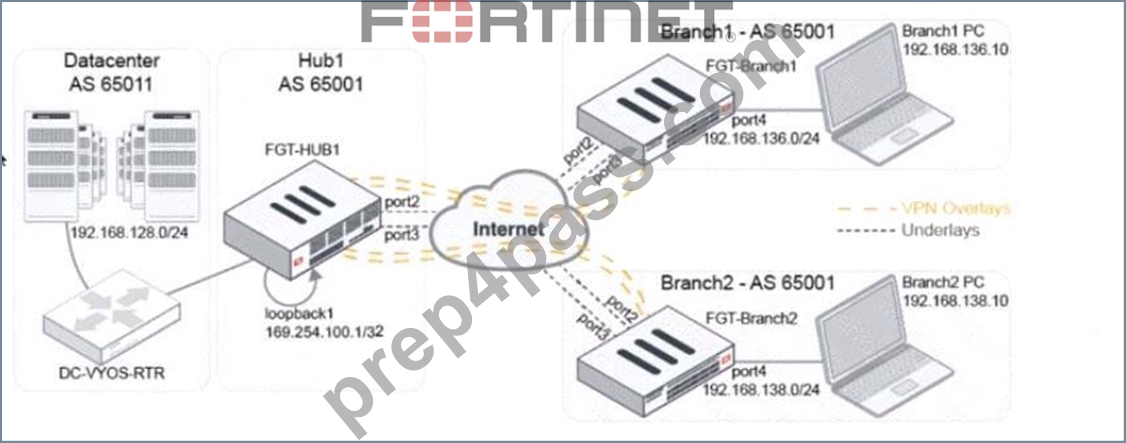
A customer wants to use SD-WAN for traffic generated from the data center towards Branches. SD-WAN on HUB should follow the underlay condition on each Branch and the solution should be scalable for hundreds of Branches.
Which SD WAN-Rules strategy should be used?
- A. Auto based on link quality
- B. Lowest Cost SLA
- C. Best Quality based on route-tags
- D. Manual based on route-tags
Answer: C
NEW QUESTION # 76
Refer to the exhibits.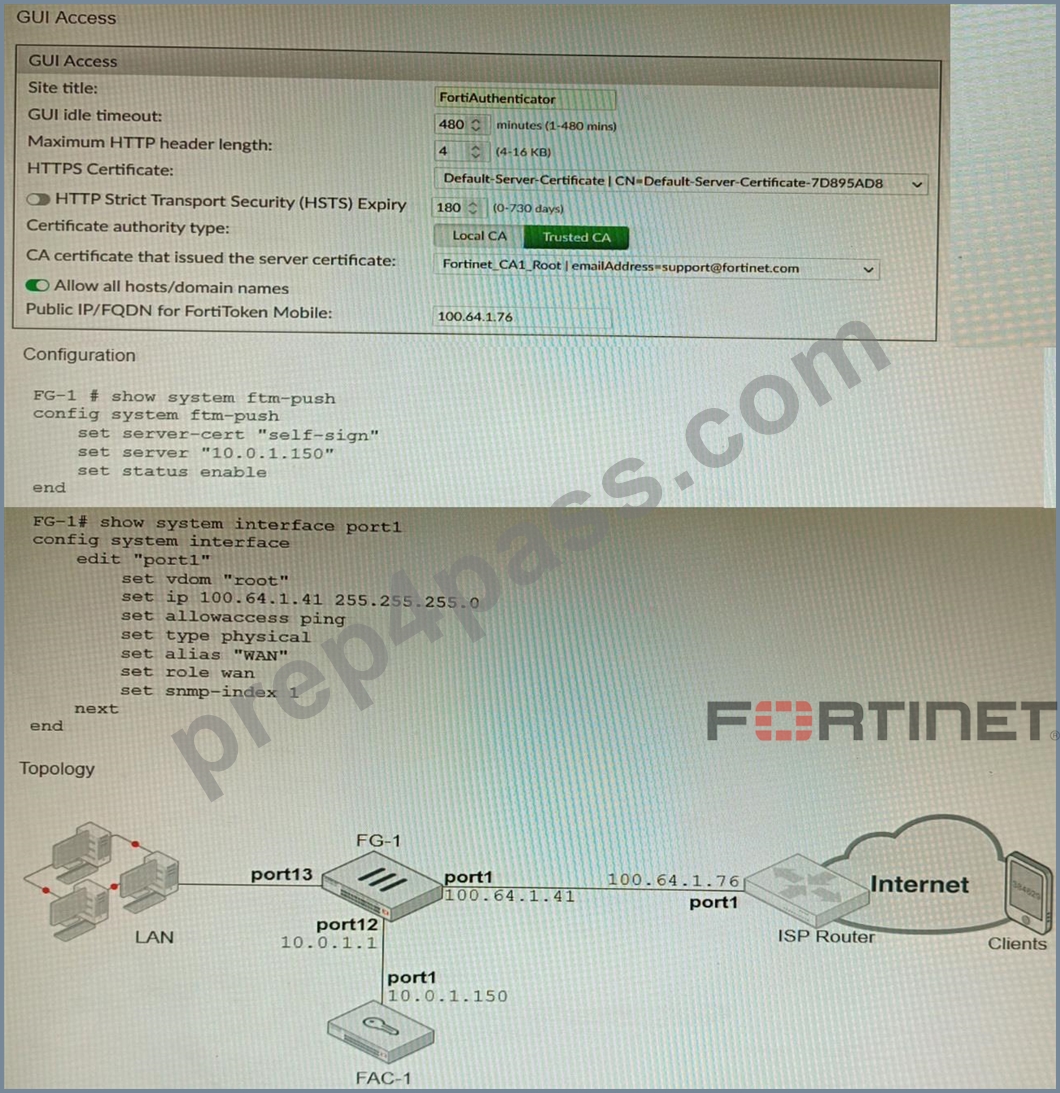
An administrator has configured a FortiGate and Forti Authenticator for two-factor authentication with FortiToken push notifications for their SSL VPN login. Upon initial review of the setup, the administrator has discovered that the customers can manually type in their two-factor code and authenticate but push notifications do not work Based on the information given in the exhibits, what must be done to fix this?
- A. On FG-1 port1, the ftm access protocol must be enabled.
- B. On FG-1 CLI, the ftm-push server setting must point to 100.64.141.
- C. FAC-1 must have an internet routable IP address for push notifications.
- D. On FAC-1, the FortiToken public IP setting must point to 100.64.1 41
Answer: C
Explanation:
FortiToken push notifications require that the FortiAuthenticator has an internet routable IP address. This is because the FortiAuthenticator uses this IP address to send push notifications to the FortiGate.
The other options are not correct. Enabling the ftm access protocol on FG-1 port1 is not necessary for push notifications to work. The ftm-push server setting on FG-1 CLI should already point to the FortiAuthenticator's IP address. The FortiToken public IP setting on FAC-1 is not relevant to push notifications.
Here is a table that summarizes the different options: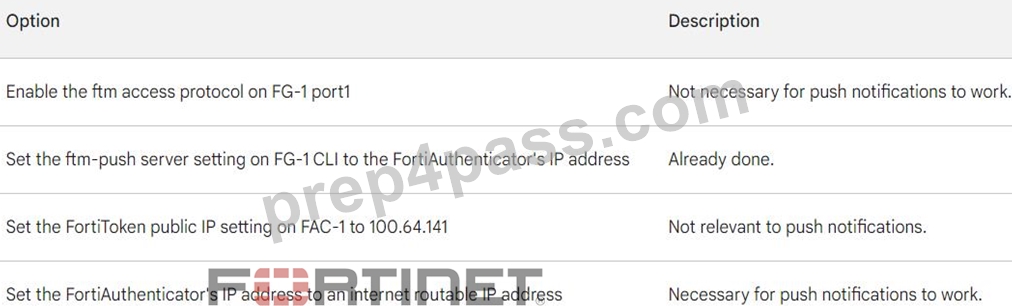
NEW QUESTION # 77
An administrator discovers that CPU utilization of a FortiGate-200F is high and determines that no traffic is being accelerated by hardware.
Why is no traffic being accelerated by hardware?
- A. Oper-session-accounting is enabled under np6xlite config.
- B. delay-tcp-npu-session is enabled under the firewall policy.
- C. check-protocol-header is set to strict in the global config.
- D. strict-dirty-session-check is enabled in global config.
Answer: C
NEW QUESTION # 78
Refer to the exhibits.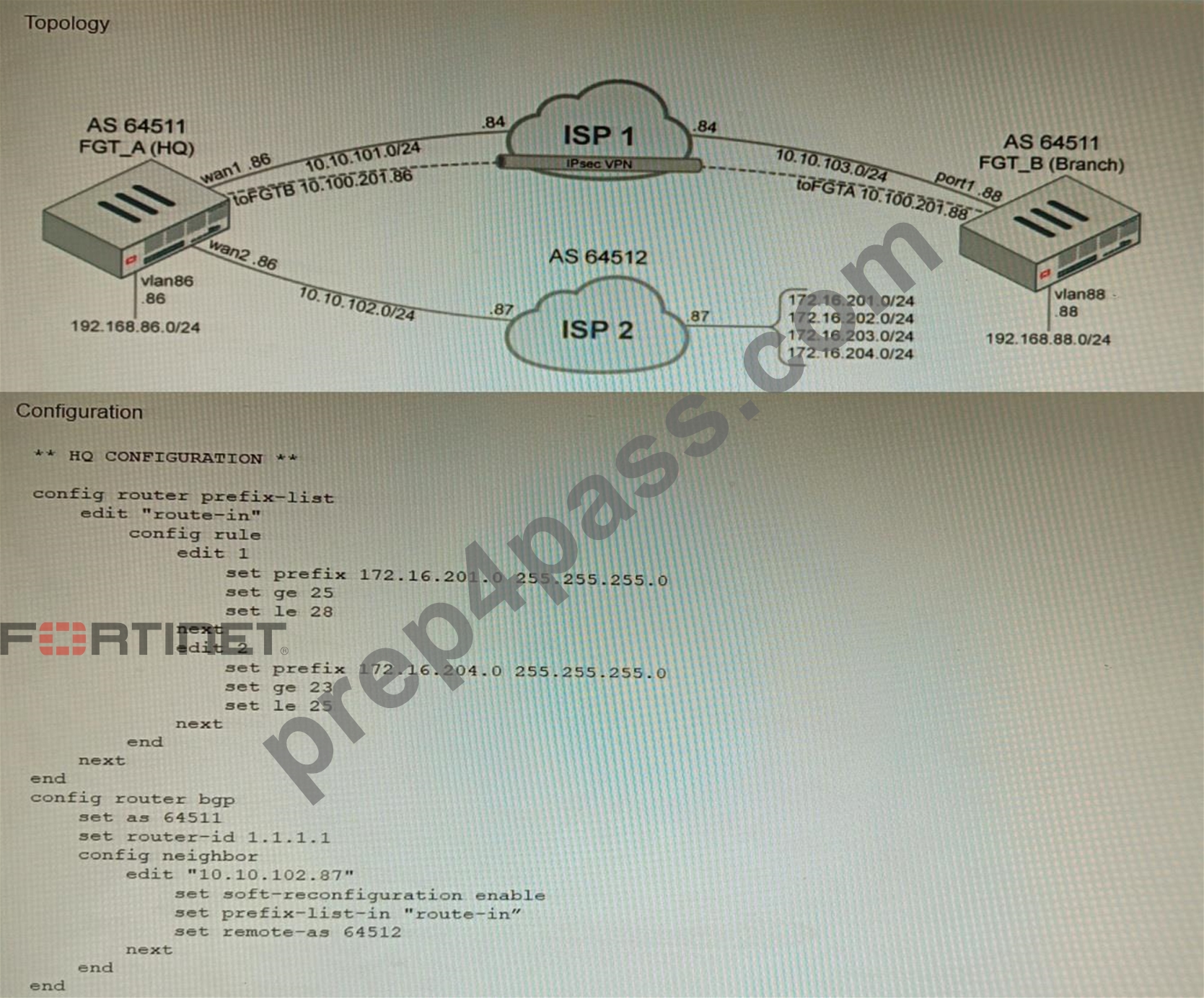
A customer has deployed a FortiGate with iBGP and eBGP routing enabled. HQ is receiving routes over eBGP from ISP 2; however, only certain routes are showing up in the routing table-Assume that BGP is working perfectly and that the only possible modifications to the routing table are solely due to the prefix list that is applied on HQ.
Given the exhibits, which two routes will be active in the routing table on the HQ firewall? (Choose two.)
- A. 172.16.204.128/25
- B. 172.16.201.96/29
- C. 172.16.204.64/27
- D. 172,620,64,27
Answer: A,C
Explanation:
The prefix list in the exhibit is configured to match prefixes that are either in the 172.16.204.0/24 subnet or in the 172.62.0.0/16 subnet. The routes that match these prefixes will be active in the routing table on the HQ firewall.
The routes that match the following prefixes will not be active in the routing table:
172.16.201.96/29
172.62.0.64/27
These routes do not match the criteria set by the prefix list.
References:
Prefix lists | FortiGate / FortiOS 7.4.0 - Fortinet Document Library
Configuring BGP | FortiGate / FortiOS 7.4.0 - Fortinet Document Library
NEW QUESTION # 79
Refer to the exhibits.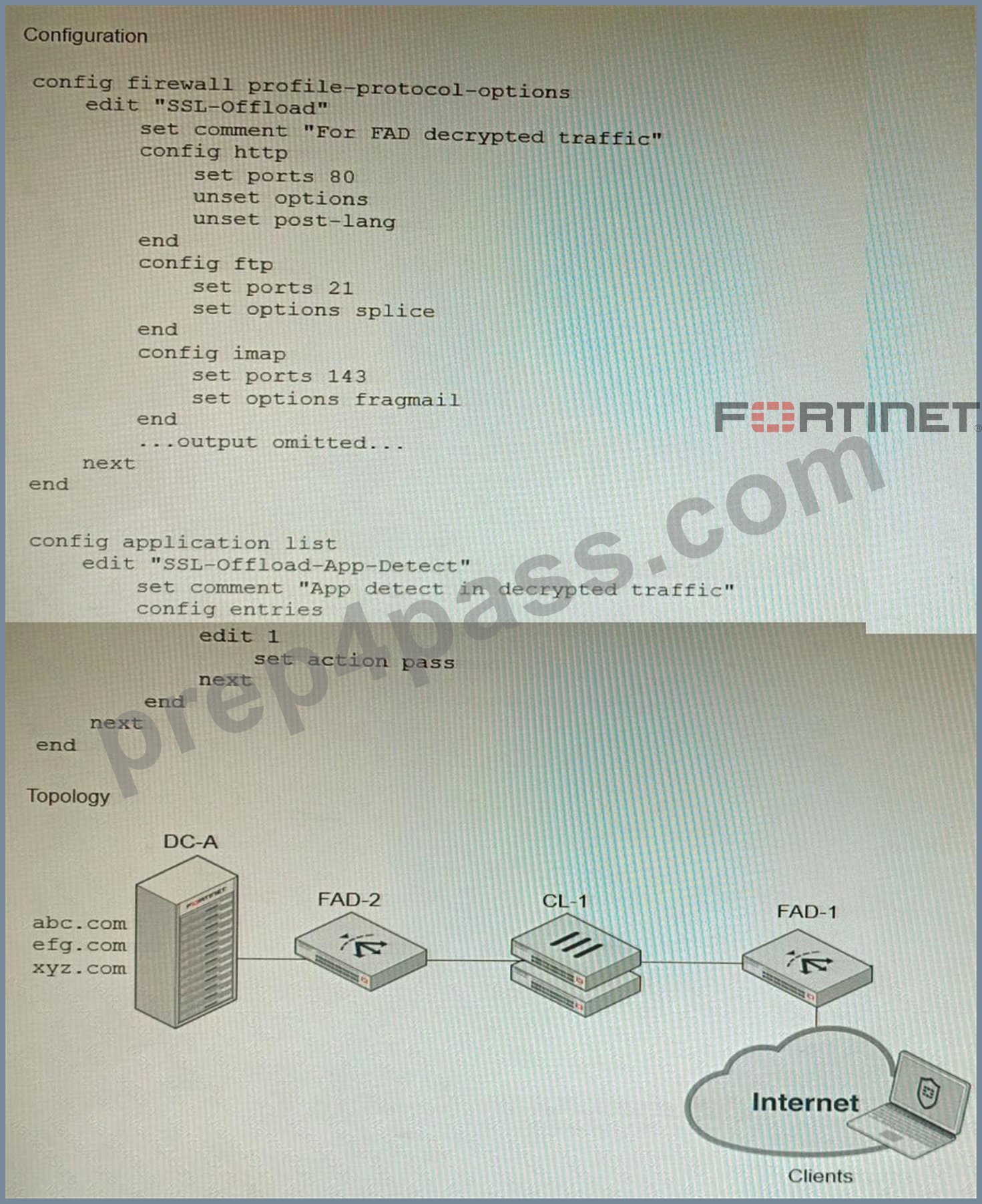
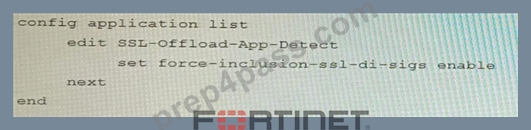
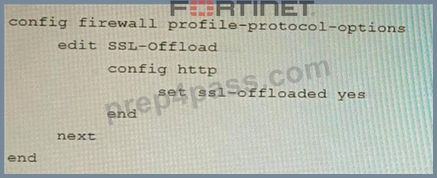
A FortiGate cluster (CL-1) protects a data center hosting multiple web applications. A pair of FortiADC devices are already configured for SSL decryption (FAD-1), and re-encryption (FAD-2). CL-1 must accept unencrypted traffic from FAD-1, perform application detection on the plain-text traffic, and forward the inspected traffic to FAD-2.
The SSL-Offload-App-Detect application list and SSL-Offload protocol options profile are applied to the firewall policy handling the web application traffic on CL-1.
Given this scenario, which two configuration tasks must the administrator perform on CL-1? (Choose two.)
- A.
- B.
- C.
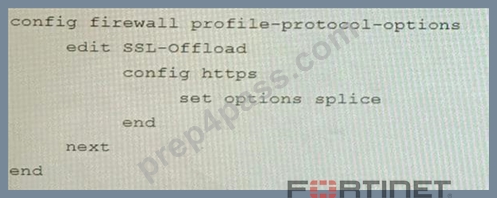
- D.
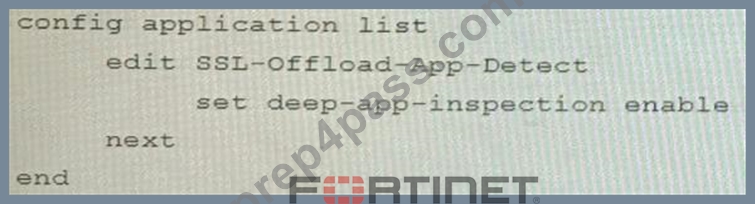
Answer: A,C
Explanation:
To enable application detection on plain-text traffic that has been decrypted by FortiADC, the administrator must perform two configuration tasks on CL-1:
* Enable SSL offloading in the firewall policy and select the SSL-Offload protocol options profile.
* Enable application control in the firewall policy and select the SSL-Offload-App-Detect application list.
References: https://docs.fortinet.com/document/fortigate/6.4.0/cookbook/103438/application-detection- on-ssl-offloaded-traffic
NEW QUESTION # 80
Refer to the exhibit.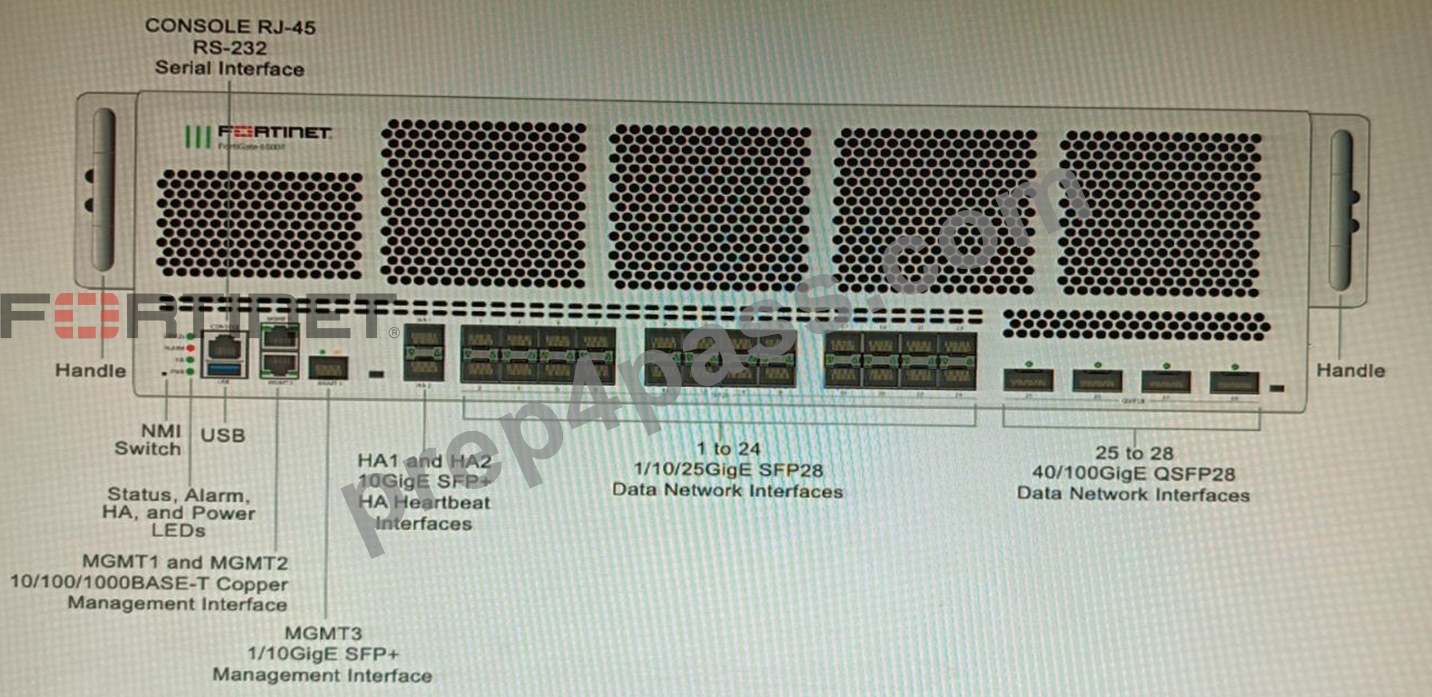
You are deploying a FortiGate 6000F. The device should be directly connected to a switch. In the future, a new hardware module providing higher speed will be installed in the switch, and the connection to the FortiGate must be moved to this higher-speed port.
You must ensure that the initial FortiGate interface connected to the switch does not affect any other port when the new module is installed and the new port speed is defined.
How should the initial connection be made?
- A. Connect the switch on any interface between ports 1 to 4
- B. Connect the switch on any interface between ports 25 to 28
- C. Connect the switch on any interface between ports 5 to 8.
- D. Connect the switch on any interface between ports 21 to 24
Answer: D
Explanation:
The FortiGate 6000F is a high-performance firewall appliance that has 28 network interfaces with different speeds and types. The device should be directly connected to a switch that will have a new hardware module providing higher speed in the future. The connection to the FortiGate must be moved to this higher-speed port without affecting any other port. Therefore, the initial connection should be made on any interface between ports 21 to 24, which are 10G SFP+ interfaces. These interfaces are independent from each other and do not share bandwidth with any other interface. This means that moving the connection to a higher-speed port in the future will not affect any other port on the FortiGate. Option A shows the correct answer. Option B is incorrect because ports 25 to 28 are 40G QSFP+ interfaces, which share bandwidth with ports 21 to 24. Moving the connection to a higher-speed port in the future will affect the bandwidth of these ports. Option C is incorrect because ports 1 to 4 are 100G QSFP28 interfaces, which share bandwidth with ports 5 to 8 and ports 9 to 12. Moving the connection to a higher-speed port in the future will affect the bandwidth of these ports. Option D is incorrect because ports 5 to 8 are 25G SFP28 interfaces, which share bandwidth with ports 1 to 4 and ports 9 to 12. Moving the connection to a higher-speed port in the future will affect the bandwidth of these ports. Reference: https://docs.fortinet.com/document/fortigate/7.0.0/hardware-acceleration-guide/19662/fortigate-6000f
NEW QUESTION # 81
......
NSE8_812 Exam Questions and Valid NSE8_812 Dumps PDF: https://questionsfree.prep4pass.com/NSE8_812_exam-braindumps.html
